Discovering Relationships Between Angles: Activities and Conjectures
This lesson focuses on understanding the relationships between pairs of angles through hands-on activities and investigations. Students will use protractors to measure angles, create clock faces, and explore the concepts of linear pairs and vertical angles. By formulating conjectures and employing problem-solving skills, learners will deepen their understanding of supplementary and complementary angles, as well as the nature of congruent angles. The lesson encourages both inductive and deductive reasoning to make connections between various angle measures and their relationships.

Discovering Relationships Between Angles: Activities and Conjectures
E N D
Presentation Transcript
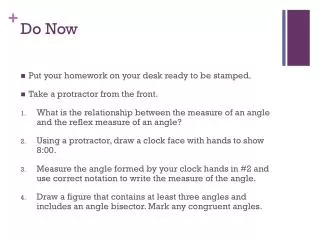
Do Now • Put your homework on your desk ready to be stamped. • Take a protractor from the front. • What is the relationship between the measure of an angle and the reflex measure of an angle? • Using a protractor, draw a clock face with hands to show 8:00. • Measure the angle formed by your clock hands in #2 and use correct notation to write the measure of the angle. • Draw a figure that contains at least three angles and includes an angle bisector. Mark any congruent angles.
Today’s Objectives • Discover relationships between pairs of angles • Perform investigations and write conjectures • Use conjectures to find missing angles measures. • Use problem solving skills
Using Inductive Reasoning to Discover Geometry • “Discovery consists of looking at the same thing as everyone else and thinking something different.” –Albert Szent-Gyorgyi
Investigation: The Linear Pair Conjecture • Step 1: Draw EHand place a point F between E and H. Choose another point G not on EHand draw FG. You have just created a linear pair of angles. Place the zero edge of your protractor along EH. What do you notice about the sum of the measures of the linear pair of angles? • Step 2: Compare your results with those of your group. Does everyone make the same observation?
Linear Pair Conjecture • If two angles form a linear pair, then ______________________. • the measures of the angles add up to 180o.
Definitions • Supplementary Angles: A pair of angles whose angle measures add up to 180o. • Complementary Angles: A pair of angles whose angle measures add up to 90o.
Investigation:Vertical Angles Conjecture • Step 1: Draw two intersecting lines onto tracing paper. Label the angles as shown. Which angles are vertical angles? • Step 2: Fold the paper so that the vertical angles lie over each other. What do you notice about their measures? • Step 3: Fold the paper so that the other pair of vertical angles lie over each other. What do you notice about their measures? • Step 4: Compare your results with the results of others.
Vertical Angles Conjecture • If two angles are vertical angles, then ____________________. • they have equal measures (they are congruent).
Inductive or Deductive? • To find The Linear Pair Conjecture? • Inductive Reasoning • To find the Vertical Angles Conjecture? • Inductive Reasoning
Using Deductive Reasoning • If we know that The Linear Pair Conjecture is true, can we use deductive reasoning to show that the Vertical Angles Conjecture must be true? • What is the sum of the measures of angles 1 and 2? • 180o • What is the sum of the measures of angles 2 and 3? • 180o • So what can you conclude about the measures of angles 1 and 3. Explain your reasoning.
Is the converse true? • Vertical Angles Conjecture: If two angles are vertical angles, then they have equal measures. • Converse: If two angles have equal measures, then they are vertical angles. • Is this valid? • No. • Counterexample?
Practice • Find the measure of each lettered angle.
Practice • If a=51 and e=52, find the measure of b, c, d, and f.
Today’s Objectives • Discover relationships between pairs of angles • Perform investigations and write conjectures • Use conjectures to find missing angles measures. • Use problem solving skills
Exit Slip • Use your two conjectures to find the missing angle measures. • Explain how you found each angle measure. • Include which conjecture(s) you used.