Understanding Protein Structure: Types, Bonds, and Functions
This chapter explores the essential roles that proteins play in biological systems, including their structural components like skin, muscles, fingernails, and hair. It explains the variable "R" group of amino acids, the formation and breaking of peptide bonds, and different types of proteins including receptor proteins involved in intercellular communication. The chapter also describes protein folding, tertiary structures, and the significance of disulfide bridges. Additionally, the concept of protein denaturation and its effects on structural integrity is discussed, alongside interactive resources for further learning.

Understanding Protein Structure: Types, Bonds, and Functions
E N D
Presentation Transcript
Purpose • Mostly for structure: skin, muscle, fingernails, hair
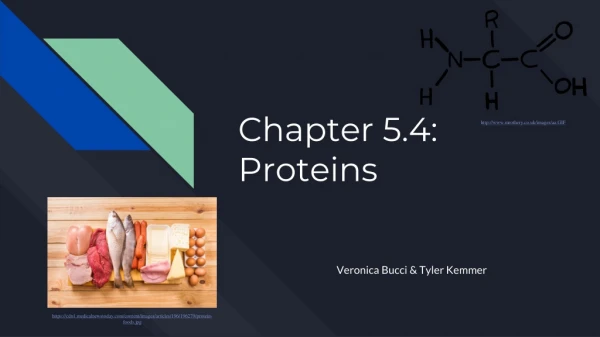
What is the “R” group? • Variable part of the amino acid • Amino Acid Chart (handout)
Type of Proteins • 8. Receptor Proteins • Intercellular communication • Bind to specific proteins (like hormones) • Receptor Proteins
Note the H-bonds (between -O of carbonyl and -H of amino):coiling and pleating
Tertiary Folding: disulfide bridges • Disulfide bridges formed between cysteine amino acids • (Look at cysteine’s structure)
Disulfide Bridges • Formed when cysteine’s sulfur join • You Tube Videos Disulfide Bonds
Use the Amino Acid Reference Sheet • Select the type of tertiary interaction as • (1) disulfide (2) ionic • (3) H bonds (4) hydrophobic • A. Leucine and valine • B. Two cysteines • C. Aspartic acid and lysine • D. Serine and threonine
ANSWERS • Select the type of tertiary interaction as • (1) disulfide (2) ionic • (3) H bonds (4) hydrophobic • A. 4 Leucine and valine • B. 1 Two cysteines • C. 2 Aspartic acid and lysine • D. 3 Serine and threonine
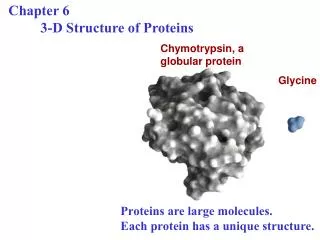
Fibrous Strands Like hair, nails,skin, muscle fibers Globular Blobs Like hemoglobin, insulin, hormones, antibodies Two Basic Shapes
Identify the level of protein structure • 1. Primary 2. Secondary • 3. Tertiary 4. Quaternary • A. Beta pleated sheet • B. Order of amino acids in a protein • C. A protein with two or more peptide chains • D. The shape of a globular protein • E. Disulfide bonds between R groups
Identify the level of protein structure • 1. Primary 2. Secondary • 3. Tertiary 4. Quaternary • ANSWERS • 2 Beta pleated sheet • 1 Order of amino acids in a protein • 4 A protein with two or more peptide • chains • 3 The shape of a globular protein • 3 Disulfide bonds between R groups
Video Stuff • Protein Denaturation Video (McGraw-Hill) • Interactive Animations: Protein Folding • Protein Structures Animation • No Sound,but great molecular models
Denaturation • Disruption of secondary, tertiary and quaternary protein structure by: • heat/organics (Break apart H bonds and disrupt hydrophobic attractions) • acids/ bases (Break H bonds between polar R groups and ionic bonds) • heavy metal ions (React with S-S bonds to form solids) • agitation (Stretches chains until bonds break)
NOTE: • Denaturation does not break the primary structure • Denaturation of an egg with a strong acid video
Protein Extra Credit OPP • Can bring in up to 5 labels (no repeats) for 1 point each with a protein term circled: • protein • peptide • amino
Proteins are Active • DO PROTEIN ACTIVITY