The Intersection of the Persian Empire and Alexander the Great: A Hellenistic Legacy
This journal examines the interaction between the Persian Empire and Alexander the Great, focusing on their influence during the Persian and Peloponnesian Wars. It explores the aftermath of Alexander's conquests, leading to the formation of the three main Hellenistic kingdoms: Seleucid, Ptolemaic, and Antigonid. Additionally, the journal discusses the spread of Greek culture in northeastern Africa and western Asia, highlighting urbanization, trade, and the intellectual achievements of the Hellenistic Age, particularly through Alexandria's Library.

The Intersection of the Persian Empire and Alexander the Great: A Hellenistic Legacy
E N D
Presentation Transcript
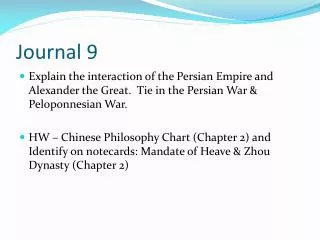
Journal 9 • Explain the interaction of the Persian Empire and Alexander the Great. Tie in the Persian War & Peloponnesian War. • HW – Chinese Philosophy Chart (Chapter 2) and Identify on notecards: Mandate of Heave & Zhou Dynasty (Chapter 2)
Watch Crash Course World History Video – Alexander the Great
Chapter 4 Hellenistic Age
Hellenistic Age (232-30 B.C.E.) • Three major kingdoms ruled by Macedonian dynasty: Seleucid, Ptolemaic, and Antigonid after Alexander’s death • Greek influence on northeastern Africa and western Asia
Hellenistic Age (232-30 B.C.E.) • Large kingdoms, heterogeneous populations, great cities, powerful rulers, widespread bureaucracies, and vast disparities in wealth • Cosmopolitan age: long distance-trade/communication, libraries, and universities, new art and literature The Laocoon; Hellenistic Art
Ptolemies • Ruled Egypt and sometimes Syria-Palestine • Took most of the pharaohs power and wealth of nation • Ruled from Alexandria (port city) • Great city with achievements in math and astronomy • Library of Alexandria Lighthouse of Alexandria
Ptolemies • Greek population in Egypt became wealthy ruling class and remained removed from Egyptian culture • Queen Cleopatra learned the language; last Ptolemy
Identify on notecards: Zhou, Mandate of Heaven • Fill in Chinese Philosophy Chart
Persia • Greece – Athens • Alexander the Great • Hellenistic Age