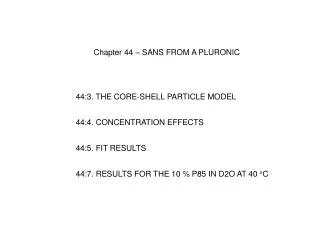
Chapter 44 – SANS FROM A PLURONIC
60 likes | 189 Views
This chapter explores the core-shell particle model of P85 Pluronic micelles in deuterated water (D2O) at 40°C, emphasizing the effects of concentration and fit results. It presents detailed structural information including the composition of the core (PPO) and shell (PEO) regions, alongside solvent interactions. The study utilizes the Percus-Yevick approach to analyze hard sphere interactions and derives results from a material balance equation, providing a comprehensive understanding of micellar behavior above the Critical Micelle Temperature (CMT).


Chapter 44 – SANS FROM A PLURONIC
E N D
Presentation Transcript
Chapter 44 – SANS FROM A PLURONIC 44:3. THE CORE-SHELL PARTICLE MODEL 44:4. CONCENTRATION EFFECTS 44:5. FIT RESULTS 44:7. RESULTS FOR THE 10 % P85 IN D2O AT 40 oC
RA A RB B 44:3. THE CORE-SHELL PARTICLE MODEL Single-particle: Spherical Bessel function:
44:4. CONCENTRATION EFFECTS Structure factor: Hard sphere interactions (Percus-Yevick): Where: Cross section:
solvent region C shell region B In the core: 2,392 PO monomers 1,648 EO monomers 1,213 D2O molecules core region A In the shell: 1,462 EO monomers 38,642 D2O molecules = 6.400*10-6 Å-2 = 5.940*10-6 Å-2 = 7.563*10-7 Å-2 RA = 43.96 Å RB = 72.91 Å 44:7. RESULTS FOR THE 10 % P85 IN D2O AT 40 oC
COMMENTS -- P85 Pluronic is formed of a triblock PEO-PPO-PEO. -- P85 Pluronic forms micelles above the Critical Micelle Temperature (CMT). -- Spherical micelles contain PPO core (hydrophobic) and PEO shell (hydrophilic). -- Core-shell form factor and hard-core interaction potential yield model for the cross section. -- Material balance equation gives detailed results about the spherical micelles.