Download
1 / 11
110 likes | 247 Views
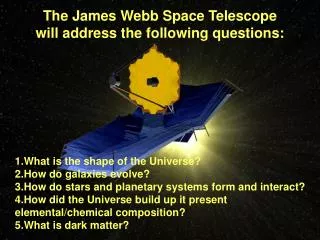
The James Webb Space Telescope will address the following questions:. What is the shape of the Universe? How do galaxies evolve? How do stars and planetary systems form and interact? How did the Universe build up it present elemental/chemical composition? What is dark matter?.

E N D
The James Webb Space Telescope will address the following questions: • What is the shape of the Universe? • How do galaxies evolve? • How do stars and planetary systems form and interact? • How did the Universe build up it present elemental/chemical composition? • What is dark matter?
Detectors are at the heart of all astronomical observations and are important for JWST
4 1.E+02 Sunshield Dark current = - 0.126 e /sec 1.E+01 - 0.020 e /sec Spectra 3 JWST requirement - 0.003 e /sec 1.E+00 Images Duration of DRM NIR Observations [yrs] JWST goal Signal [e-/sec/pix] 2 1.E-01 R=5 1.E-02 Zodiacal Light 1 1.E-03 R=1000 0 1.E-04 2 4 6 8 0.1 1 10 Wavelength [mm] Read noise per exposure [electrons] Detectors Are Important for JWST
HST HST HST JWST Detectors HST/NICMOS (all astronomical infrared detectors in space today!) ~80 megapixels of flight-qualified detectors!!! (~10 times all detectors on all telescopes today)
IR Arrays are “Hybrid” Sensors • PN junctions are “bump bonded” to a silicon readout multiplexer (MUX). • Silicon technology is more advanced than other semiconductor electronics technology. • The “bump bonds” are made of indium. from: Bernard J. Rauscher, in “Detectors,” STScI Course on Infrared Instrumentation & Observing Techniques, 2000
NIRCam will use detectors from:Rockwell Scientific Company (RSC)/U Hawaii ~$500K per array! 2"
STScI Detector Test System Controller Electronics Dewar Entrance Window Vacuum Hose He Lines