Absolute Monarchs of Europe
Absolute Monarchs of Europe. The First Czar. Ivan the Terrible In 1533, Ivan the Terrible becomes king of Russia Struggles for power with boyars —landowning nobles. Seizes power and is crowned czar, meaning “caesar” Rule by Terror

Absolute Monarchs of Europe
E N D
Presentation Transcript
The First Czar • Ivan the Terrible • In 1533, Ivan the Terrible becomes king of Russia • Struggles for power with boyars—landowning nobles. • Seizes power and is crowned czar, meaning “caesar” • Rule by Terror • In 1560, Ivan turns against boyars, kills them, seizes lands • Rise of the Romanovs • Ivan’s heir is weak, leading to period of turmoil • In 1613, Michael Romanov becomes czar
Peter the Great Comes to Power • The Rise of Peter • Peter the Great becomes czar in 1696, begins to reform Russia • Russia Contrasts with Europe • Cut off geographically from Europe • Culturally isolated, little contact with western Europe • Religious differences widen gap
Peter Rules Absolutely • Peter Visits the West • In 1697, Peter visits western Europe to learn European ways • Peter’s Goal • Goal of westernization—using western Europe as a model for change • Peter’s Reforms • Brings Orthodox Church under state control • Reduces power of great landowners • Modernizes army by having European officers train soldiers
Peter Rules Absolutely (continued) • Westernizing Russia • Introduces potatoes • Starts Russia’s first newspaper • Raises women’s status • Adopts Western fashion • Advances education
Peter Rules Absolutely (continued) • Establishing St. Petersburg • Peter wants a seaport that will make travel to West easier. • Fights Sweden to win port on Baltic Sea • In 1703, begins building new capital called St. Petersburg. • Building city takes many years, many serfs die in process. • By the time of Peter’s death, Russia is force to be reckoned with in Europe
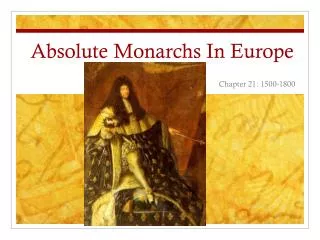
Louis XIV • Background • Grandfather – Henry IV enacted the Edict of Nantes • Cardinal Richelieu helped Louis’ dad establish control of France
Louis’ Background • Louis became king at 4 years old when his father died • Louis grew hate the nobility, because of the riots that tore France apart during his childhood
“L’ètat, e’est moi” • “I am the state” • Louis’ view was that he and the state were one in the same • He became the most powerful ruler in French history
Louis attacks the Nobility • Louis excluded the nobility from the French councils • He increased the power of government agents called intendants • The intendants collected taxes
Louis is devoted to making France an Economic Power • Jean Baptiste Colbert became Louis’ minister of finance • He wanted to make France self-sufficient • Colbert developed the theory of mercantilism: • Wanted to export (send goods over seas) more than you import (bring goods in from over seas)
French Military Campaigns • Louis spent his $ on military campaigns to expand French boundaries • These wars almost bankrupted the country • Countries learned to join together to defeat France
War of Spanish Succession • The Spanish king left his throne to Louis XIV grandson in 1700 • Europe was outraged & worried about the two biggest powers being united by blood
War of Spanish Succession • This war lasted 13 years & France lost • Louis lost 3 out of 4 sons • His grandson will become king of Spain • Louis died in 1715
Louis’ Legacy • When Louis died in 1715 • Mixed legacy: • Positive: France ranked above all other European nations in art & literature. Also considered the military leader of Europe • Negative: Constant warfare & the construction of the Palace of Versailles put France into staggering debt. Plus the poor were burdened by high taxes
James I [r. 1603-1625] James I’s speech to the House of Commons: I am surprised that my ancestors should ever be permitted such an institution to come into existence. I am a stranger, and found it here when I arrived, so that I am obliged to put up with what I cannot get rid of!
James I [r. 1603-1625] • Wanted absolute power. • He quickly alienated a Parliament grown accustomed under the Tudors to act on the premise that monarch and Parliament TOGETHER ruled England as a “balance polity.”
James I [r. 1603-1625] • Problems he faced: • Large royal debt. • Believed in Divine Right of Kings. • Pro-Catholic sympathies. • Clashed with Parliament • He raised money without Parliament’s consent!
Charles I [r. 1625-1649] • Pro-ceremonies and rituals. • Uniformity of church services imposed by a church court. • Anglican Book of Common Prayer for both England AND Scotland. • Seen as too pro-Catholic by the Puritans.
Charles I & Parliament • Constantly at war with Spain and France. • Always need £, but how to get it?? • Usually Parliament would give Charles £ from taxes to fund his wars. • Periodically, Parliament would deny funds. • In return, Charles would dissolve Parliament and try to rule England without it find funds in other ways. • Forced “loans,” selling aristocratic titles, etc.
The Petition of Rights, 1628 • In return for money to fund his wars, Charles I agreed: • No imprisonment without due cause. • No taxation without Parliament’s consent. • No putting soldiers in private homes. • No martial law during peacetime. • Charles signed it, and then ignored it, dissolving Parliament!
The “Short” Parliament • “Short Parliament” • No Parliament in 20 yrs. • Charles need £ war with France. • Calls Parliament into session in 1640 • MPs demand more protection of property. • Charles dismisses them after 3 weeks. Charles I by Van Dyck (1633)
The “Long” Parliament • In session from 1640 to 1660. • Triennial Act passed Parliament must be called in session at least once every 3 yrs. • Parliament can’t be adjourned without its own consent! • Charles enters the House of Commons to end the session and arrest 5 MPs unsuccessful • Charles heads north to form an army!
The Civil War (1642-1649)
Civil War (1642-1649) Royalists(Cavaliers) Parliamentarians(Roundheads) • House of Lords • N & W England • Aristocracy • Large landowners • Church officials • More rural • House of Commons • S & E England • Puritans • Merchants • Townspeople • More urban
Allegiance of Members of the Long Parliament (1640-1660)
Oliver Cromwell [1599-1658] • Officer of the Parliamentary army [cavalry] the New Model Army. • Led the army that defeated royal forces and now controlled the government. • He wore…a plain cloth-suit, which seemed to have been made by a poor tailor; his shirt was plain, and not very clean; and I remember a speck or two of blood upon his collar…his face was swollen and red, his voice sharp and untunable, and his speech full of passion. [Sir Philip Warwick, a Royalist, 1640]
The Battle of Naseby [re-enactment], 1645 • Charles I is defeated at Marston Moor, Naseby, and Preston. • He is handed over to Parliament.
The Interregnum (1649-1660)
The “Interregnum” Period [1649-1660] • The Commonwealth (1649-1653) • The Protectorate (1654-1660)
Pride’s Purge, 1648 • Cromwell purges the House of Commons of moderates [anyone who isn’t anti-monarchy]. • The results is the “Rump” Parliament.
The Puritan Commonwealth [1649-1653] • Cromwell rules with the Rump Parliament. • Constitutional Republic • Created a constitution Instrument of Government • An executive [Cromwell] • A Council of State annually elected the committee of Parliament. • No monarch. • Europe is appalled other nations don’t recognize it.
The Protectorate [1653-1660] • Cromwell tears up the ineffective Constitution. • Dismisses the Rump Parliament and rules with the support of the military. • Declares martial law. • Military dictator. • Religious tolerance for all [esp. for Jews], except for Catholics. • Crushes a rebellion in Scotland. • Crushes a rebellion among the Catholics of Ireland kills 40% of all ethnic Irish!