Download
1 / 32
320 likes | 449 Views
In this comprehensive exploration by Prof. Dr. Ichsan Setya Putra from Telkom University, the evolving role of faculty members as professional educators is emphasized. The discourse underscores the importance of continuous professional development, integrating best practices in teaching, and engaging deeply with the literature on college teaching. Key themes include the scholarship of teaching, fostering effective learning experiences, and the essential attributes of quality educators. This presentation serves as a guide to enhancing pedagogical approaches within higher education.

E N D
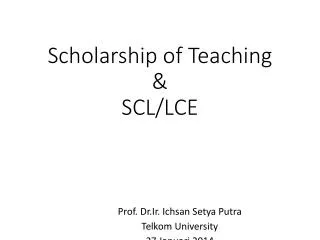
Scholarship of Teaching&SCL/LCE Prof. Dr.Ir. IchsanSetya Putra Telkom University 27 Januari 2014
Prof. Dr.Ir.Ichsan S.Putra Dosen Program Studi .... sekaligus Ketua SPM ITB
FACULTY MEMBERS: • Who Are We?What Qualities Do We Value? • NOW: We primarily see ourselves as.. • SUBJECT MATTER SPECIALISTS • NEW CHALLENGE: We need to also see ourselves as… • PROFESSIONAL EDUCATORS • All professionals value their own Professional Development very seriously. L. Dee Fink: The JOY and RESPONSIBILITY of TEACHING WELL Mengajar Efektif & Kreatif Prof. Dr. Ichsan S. PutraKomisi Pembelajaran - Institut Teknologi Bandung, INDONESIA
WHO We Are - WHAT We Value • We are Professional Educators. • We value being First-Rate Professionals. • We valuelearning how to do our work as well as possible. L. Dee Fink: The JOY and RESPONSIBILITY of TEACHING WELL Mengajar Efektif & Kreatif Prof. Dr. Ichsan S. PutraKomisi Pembelajaran - Institut Teknologi Bandung, INDONESIA
FACULTY as “PROFESSIONAL EDUCATORS”: • What would that mean? • That faculty members, as college teachers, will: • Be familiar with the literature on college teaching, • Use the ideas of “best practice” in their own teaching, and • Engage in continuous improvement regarding current ideas on teaching and their teaching. L. Dee Fink: The JOY and RESPONSIBILITY of TEACHING WELL Mengajar Efektif & Kreatif Prof. Dr. Ichsan S. PutraKomisi Pembelajaran - Institut Teknologi Bandung, INDONESIA
Interacting with Students Knowledge of the Subject Matter Designing Learning Experiences Managing the Course FUNDAMENTAL TASKS OF TEACHING Beginning of the Course L. Dee Fink: The JOY and RESPONSIBILITY of TEACHING WELL
Ideas/Literature on COLLEGE TEACHING 2 3 LEARN REFLECT SHARE 1 USE ASSESS COLLEAGUES The Learning Cycle: 3 WAYS OF LEARNING L. Dee Fink: The JOY and RESPONSIBILITY of TEACHING WELL
Quality of Teaching (now) Time RATE of Improvement from: DIFFERENT WAYS of Learning About Teaching 1 + 2 + 3: Ideas from Literature on College Teaching 1 + 2: Learning from Others 1: Only from Own Experience L. Dee Fink: The JOY and RESPONSIBILITY of TEACHING WELL
Boyer: Scholarship Reconsidered The Boyer Model Taxonomy • …give the ..term “scholarship” a broader more capacious meaning, one that brings legitimacy to the full scope of academic work. • Boyer p. 16
Scholarship of Teaching Scholarship of Integration Scholarship of Application Scholarship of Discovery • 1990 Carnegie Report Scholarship Reconsidered Boyer, E.L., . Scholarship Reconsidered, Priorities of the Professoriate, Carnegie, 1990
Shulman: Taking Learning Seriously An intelligent act becomes scholarship when: • It becomes public • It is critically reviewed and evaluated by one’s community • Members of one’s community begin to use, build upon, and develop these acts of mind and creation. Shulman, L. (1999). Taking learning seriously. Change. 31(4), pp. 5-7
Glassick et al: Scholarship Assessed Standards of Scholarly Work(Glassick, Huber, Maeroff) • Clear Goal • Adequate Preparation • Appropriate Methods • Significant Results • Effective Presentation • Reflective Critique
Mary Taylor Huber Scholarship of Teaching Defined Sustained inquiry into the question of when, how, and under what conditions students learn. -- Huber
Glassick et al: Scholarship Assessed Standards of Scholarly Work(Glassick, Huber, Maeroff) • Clear Goal • Adequate Preparation • Appropriate Methods • Significant Results • Effective Presentation • Reflective Critique
Harris & Cullen: Leading the Learner Centered Campus, Jossey Bass 2010 Our Current Challanges • New Knowledge • Change in Perception • Demographic Changes • Industry & Market Changes • Process Needs
Educating Engineers for the 21st Century: the Industry View The Royal Academy of Engineering, 2006 Industry & Market Changes Engineers to have a sound knowledge of the engineering fundamentals within their discipline as well as social & interpersonal skill set including communication, team working, & business skills
Vest, Educating Engineers for 2020 & Beyond, http: mitworld.mit.edu Industry & Market Changes …called for engineering graduates to “write & communicate well, think about ethics & social responsibility, conceive & operate systems of great complexity within a framework of sustainable development & be prepared to live & work as global citizens
Kalantizis & Cope, Transformation in Language & Learning: Perspectives on Multiliteracies Industry & Market Changes …is replaced by ‘multiskilled’ all round workers who are flexible enough to be able to do complex & integrated work. Their strength is not in career stability & content knowledge but in range & versatility.
Harris & Cullen: Leading the Learner Centered Campus, Jossey Bass 2010 Perfect Storm For Shifting Paradigm Instructional Centered Vs Learner Centered
Paradigma Sebagai Cara Memandang http://www.evidentcrimescene.com/cata/photo2/photo2.html http://www.filmphoto.net/camera_filters.html
Student is Student Coming Late !!!