E.U.-U.S. Joint Research Symposium #2: Advancing Research Implementation Strategies
The E.U.-U.S. Joint Research Symposium #2, held in Paris in April 2014, focused on research implementation within the transportation sector. Bringing together 50 experts from academia, industry, and government, the symposium addressed challenges in translating research into practice, identified success factors, and discussed innovative strategies for collaboration. Participants developed white papers to share insights and recommendations for overcoming barriers to effective research implementation, fostering transatlantic partnerships, and enhancing transportation innovation.

E.U.-U.S. Joint Research Symposium #2: Advancing Research Implementation Strategies
E N D
Presentation Transcript
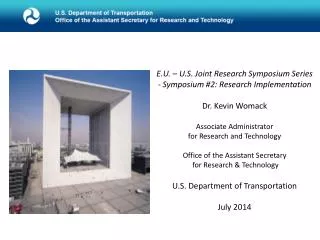
E.U. – U.S. Joint Research Symposium Series- Symposium #2: Research ImplementationDr. Kevin WomackAssociate Administrator for Research and TechnologyOffice of the Assistant Secretary for Research & TechnologyU.S. Department of TransportationJuly 2014
Background • Implementing Arrangement with European Commission (DG-RTD) signed in Feb 2013 • Four annual E.U. – U.S. research symposia planned (2013 – 2016) in partnership with European Commission and TRB • Symposia series designed to facilitate transatlantic research collaboration, identify knowledge gaps, and potential future joint research opportunities • First symposium hosted by the U.S. in May 2013: “City Logistics Research – a Transatlantic Perspective”
2014 Symposium • Topic: Research Implementation • Hosted by the European Commission in La Defense (Paris), France, on April 10-11, 2014 • 50 experts from academia, industry, and government invited to attend the two-day symposium (25 U.S., 25 E.U.) • Two white papers developed to inform symposium discussions: • ‘Transportation research implementation in the European Union and the United States - Observations and Working Hypotheses’ • ‘Lessons learned from case studies of successful research implementation in Europe and the United States’
Agenda DAY 2 • Session 4: Using research results in effective ways • Luis López RUIZ (Director of Engineering and Innovation ADIF) • Allen BIEHLER (Carnegie Mellon University) • Chris MARTIN (Robert Bosch Corporate Research) • Natalia de ESTEVAN (Transport for London) • Breakout session 2: Identifying the success factors • Session 5: From principles to practice • Co-Chairs: MaritBrandtsegg & William Millar • Reports from Breakout Session 2 • Conclusive keynote address: Kirk STEUDLE (TRB Executive Committee Chair); • Concluding observations DAY 1 • Session 1: Setting the Scene • White paper summaries • Keynote speech – Terry Hill, Arup • Breakout session 1: Stakeholder perspectives on implementation • Session 2: Institutional incentives and disincentives to successful implementation • Ann Brach, SHRP2 • Steve Phillips, Sec. General CEDR • Michael TRENTACOSTE (FHWA, Director TFHRC) • Liam Breslin, European Commission • Session 3: Framing and conducting research to insure implementation • Jose VIEGAS (Sec.General ITF) • Stephen ANDRLE (Dep. Director SHRP 2); • Horst SCHULZE (German Federal Highway Research Institute - BASt);
Issues • Two major obstacles in the research implementation process: • “Valley of death” between research completion and research implementation • Tracking research implementation and understanding its impacts – capturing and articulating Return on Investment • Institutional barriers to effective research implementation (e.g. legislative, procurement, and Intellectual Property processes) • Lack of ability to manage “risk” • Three primary stakeholder groups tend to be isolated or “siloed” (researchers, funders, end users) • Fragmented nature of the U.S. transportation research universe (compared to a more structured framework approach in the E.U.) • Lack of incentives within academia to prioritize research implementation • Lack of investment in basic and advanced research – how does this fit in the research implementation process?
Recommendations • Establish and maintain strong partnerships between stakeholder groups (academia, funders, end users) • Establish “culture of innovation”, beginning with leadership • Identify and engage end users throughout the research process, not just at the end • Provide incentives to the academic community to support research implementation • Implement a systematic, long term approach to research funding and implementation that supports basic, advanced, and applied research • Pursue legislative, policy, IP, and procurement perform to remove the institutional barriers to effective research implementation • Delegate responsibility for research implementation to specific organizations, or establish such organizations if they don’t already exist • Provide resources to track research implementation and impacts • Identify best practice models and facilitate their adoption elsewhere • Every Day Counts, SHRP2, DARPA, EC Framework Programs, IDEA, etc
Next Steps • Conference proceedings document to be produced later this year – disseminate to transportation community and obtain feedback • Further formal discussion at TRB Annual Meeting 2015, building consensus for future action items • Assess the need for a “primer” on research implementation – objectives, content, audience • Begin implementing action items in 2015
Questions / Comments?Dr. Kevin WomackAssociate Administrator for Research and TechnologyOffice of the Assistant Secretary for Research & TechnologyU.S. Department of TransportationJuly 2014