Mastering Factored Form: Graphing Parabolas and Identifying Zeros
70 likes | 193 Views
In this lesson, we will explore the factored form of quadratic equations and its significance in graphing parabolas. You will learn how to identify zeros, also known as roots or x-intercepts, and how to determine the axis of symmetry and vertex of a parabola. We will practice factoring equations, finding zeros, and graphing the results. This will prepare you for advanced topics like complex trinomial factoring and the difference of squares. Remember, our test on factoring is coming up on October 28th!


Mastering Factored Form: Graphing Parabolas and Identifying Zeros
E N D
Presentation Transcript
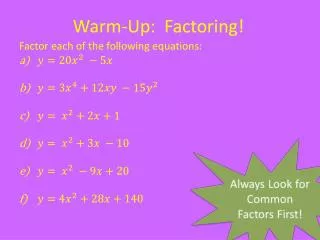
Warm-Up: Factoring! Factor each of the following equations:
Unit 3Graphing Parabolas from Factored Form LG: I can use the factored form of a quadratic equation to sketch a parabola
Factored Form of Quadratic Equations • Recall: What info does factored form tell us? • General Form: , where s and t are the zeros of the parabola • Note: Zeros are also called “roots”, “solutions”, or the“x-intercepts” of a quadratic equation • Examples: What are the zeros in the following equations? a) b) Remember: at the x-intercepts, y =0
What can we do with Zeros? • Back to example a: • What are the zeros? b) Where is the axis of symmetry? c) Where is the vertex?
Practice: • Factor the equation • Find the zeros • Find the axis of symmetry • Find the vertex • Graph it!
Practice • Pg. 281 # 5ace, 7ace • Pg. 376 # 4a,f (i, ii, iv) • (plus any factoring questions not completed last night) What’s to come: • Tomorrow: Complex Trinomial Factoring and Difference of Squares Factoring • Factoring Test: Monday October 28th