Understanding Computer Networks and the Internet: Structure, Protocols, and Security Insights
This overview covers the fundamentals of computer networks and the Internet, exploring their hierarchical structure and components. We delve into end systems, access networks, and the core network, discussing circuit and packet switching, delay, loss, and throughput. Key concepts include protocol layers and service models, alongside the implications of network security challenges. The lecture highlights the organization of the Internet as a network of networks, emphasizing the importance of protocols in communication and providing insights into both human and machine interactions within network systems.

Understanding Computer Networks and the Internet: Structure, Protocols, and Security Insights
E N D
Presentation Transcript
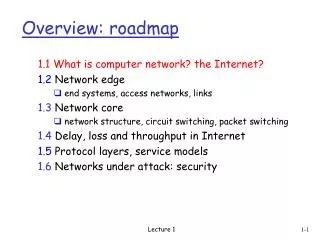
Overview: roadmap 1.1 What is computer network? the Internet? 1.2Network edge • end systems, access networks, links 1.3 Network core • network structure, circuit switching, packet switching 1.4 Delay, loss and throughput in Internet 1.5 Protocol layers, service models 1.6 Networks under attack: security Lecture 1
How is the Internet Organized • A hierarchical structure. • hosts combine to form a Local Area Network (LAN). • LANs combine to form an Autonomous System (AS) • Autonomous Systems combine to form the Internet. Internetworkednetworks– Internet ! Lecture 1
millions of connected computing devices: hosts = end systems running network apps PC Mobile network server Global ISP wireless laptop cellular handheld Home network Regional ISP access points wired links Institutional network router What’s the Internet: “nuts and bolts” view • communication links • fiber, copper, radio, satellite • transmission rate = bandwidth • routers: forward packets (chunks of data) Lecture 1
protocolscontrol sending, receiving of messages e.g., TCP, IP, HTTP, Skype, Ethernet etc. Internet: “network of networks” public Internet versus private intranet Internet standards RFC: Request for comments Mobile network Global ISP Home network Regional ISP Institutional network What’s the Internet: “nuts and bolts” view Lecture 1
a human protocol and a computer network protocol: Hi Hi Got the time? 2:00 time What’s the Internet: an operational view human protocol Lecture 1
human protocols: … specific msgs sent … specific actions taken when msgs received, or other events network protocols: machines rather than humans all communication activity in Internet governed by protocols What’s the Internet: an operational view Lecture 1
a human protocol and a computer network protocol: Hi TCP connection req. Hi TCP connection reply. Get http://jjcweb.jjay.cuny.edu/ssengupta/slide.ppt Got the time? 2:00 <file> time What’s a protocol? human protocol Internet protocol example Lecture 1
human protocols: … specific msgs sent … specific actions taken when msgs received, or other events network protocols: machines rather than humans all communication activity in Internet governed by protocols protocols define format, order of msgs sent and received among network entities, and actions taken on msg transmission, receipt What’s the Internet: an operational view Lecture 1
Take home messages • According to you, what are the three most important physical components of computer network? • Name four Internet applications? • What does a network protocol do? Lecture 1