Download
1 / 1
10 likes | 109 Views
This study explores the diversity of rice cultivars using Wx protein analysis, including non-waxy and waxy varieties. SDS-PAGE of different rice accessions including wild types and landraces is presented. The sizes of markers and controls are also described.

E N D
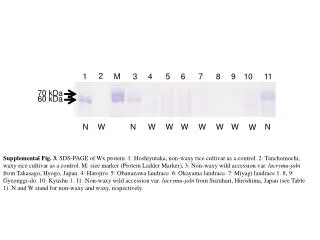
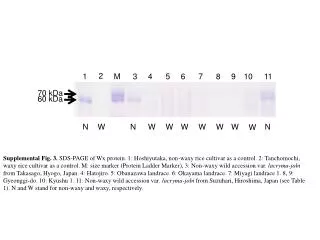
2 1 M 3 4 5 6 7 8 9 10 11 70 kDa 60 kDa N W N W W W W W W N W Supplemental Fig. 3. SDS-PAGE of Wx protein. 1: Hoshiyutaka, non-waxy rice cultivar as a control. 2: Tanchomochi, waxy rice cultivar as a control. M: size marker (Protein Ladder Marker), 3: Non-waxy wild accession var. lacryma-jobi from Takasago, Hyogo, Japan. 4: Hatojiro. 5: Obanazawa landrace. 6: Okayama landrace. 7: Miyagi landrace 1. 8, 9: Gyeonggi-do. 10: Kyushu 1. 11: Non-waxy wild accession var. lacryma-jobi from Suzuhari, Hiroshima, Japan (see Table 1). N and W stand for non-waxy and waxy, respectively.