Download

1 / 18
240 likes | 406 Views
This analysis explores plant nutrition, focusing on essential macronutrients and micronutrients required for healthy growth. Key elements like carbon, hydrogen, oxygen, nitrogen, and various minerals are discussed, including their roles in plant health. The document examines nutrient deficiencies and the importance of fertilizers and irrigation. Additionally, it highlights symbiotic relationships such as nitrogen fixation by bacteria and the function of mycorrhizae in enhancing nutrient uptake through mutualistic associations. Understanding these interactions is crucial for effective plant cultivation and sustainability.

E N D
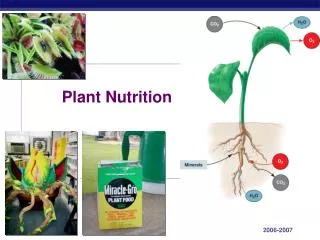
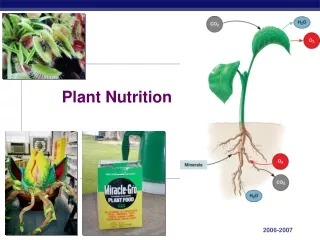
H2O CO2 O2 LE 37-2 O2 Minerals CO2 H2O
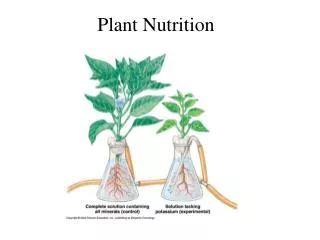
LE 37-3 Experimental: Solution without potassium Control: Solution containing all minerals
Nutrients Macronutrients Micronutrients • essential elements • plants require them in relatively large amounts • Carbon • Oxygen • Hydrogen • Nitrogen • Potassium • Calcium • Magnesium • Phosphorous • Sulfur • plants require them in very small amounts
Healthy LE 37-4 Phosphate-deficient Potassium-deficient Nitrogen-deficient
LE 37-7 No phosphorus deficiency Beginning phosphorus deficiency Well-developed phosphorus deficiency
Fertilizers • Irrigation • Erosion • Topsoil loss • Contour tillage
Nitrogen Fixation • Nitrogen-fixing bacteria • convert atmospheric N2 to nitrogenous minerals usable by plants • Symbiotic relationship (mutualistic)
5 µm LE 37-10 Bacteroids within vesicle Nodules Roots Pea plant root. Bacteroids in a soybean root nodule.
Mycorrhizae and Plant Nutrition • Mycorrhizae • mutualistic associations of fungi and roots • fungus benefits • steady supply of sugar from the host plant • host plant benefits • fungus increases the surface area for water uptake and mineral absorption
Two Main Types of Mycorrhizae • Ectomycorrhizae • mycelium of the fungus forms a dense sheath over the surface of the root
LE 37-12a Epidermis Cortex Mantle (fungal sheath) 100 µm Endodermis Fungal hyphae between cortical cells Mantle (fungal sheath) (colorized SEM) Ectomycorrhizae.
Endomycorrhizae • microscopic fungal hyphae extend into the root
LE 37-12b 10 µm Cortex Epidermis Cortical cells Endodermis Fungal hyphae Vesicle Casparian strip Root hair Arbuscules (LM, stained specimen) Endomycorrhizae.
Epiphytes, Parasitic Plants, and Carnivorous Plants LE 37-13a Staghorn fern, and epiphyte. This tropical fern (genus Platycerium) grows on large rocks, cliffs, and trees. It has two types of fronds: branched fronds resembling antlers and circular fronds that form a collar around the base of the fern.
LE 37-13b Host’s phloem Dodder Haustoria Mistletoe, a photosynthetic parasite. Indian pipe, a nonphotosynthetic parasite. Dodder, a nonphotosynthetic parasite.
LE 37-13c Venus’ flytrap. Pitcher plants. Sundews.