Download
1 / 1
10 likes | 113 Views
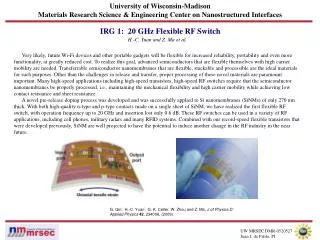
Explore the development of advanced semiconductor nanomembranes for high-speed RF switches in portable gadgets. Discover the benefits of transferring flexible and processible semiconductor nanomembranes for future Wi-Fi devices. Overcome challenges in processing these materials to maintain flexibility, carrier mobility, and achieve low contact resistance. The novel pre-release doping process enables the creation of flexible RF switches with high operation frequency and minimal insertion loss. These RF switches have diverse applications in cell phones, military radars, and RFID systems, shaping the future of the RF industry.

E N D
University of Wisconsin-Madison Materials Research Science & Engineering Center on Nanostructured Interfaces UW MRSEC DMR-0520527 Juan J. de Pablo, PI IRG 1: 20 GHz Flexible RF Switch H.-C. Yuan and Z. Ma et al. Very likely, future Wi-Fi devices and other portable gadgets will be flexible for increased reliability, portability and even more functionality, at greatly reduced cost. To realize this goal, advanced semiconductors that are flexible themselves with high carrier mobility are needed. Transferrable semiconductor nanomembranes that are flexible, stackable and processible are the ideal materials for such purposes. Other than the challenges in release and transfer, proper processing of these novel materials are paramount important. Many high-speed applications including high-speed transistors, high-speed RF switches require that the semiconductor nanomembranes be properly processed, i.e., maintaining the mechanical flexibility and high carrier mobility while achieving low contact resistance and sheet resistance. A novel pre-release doping process was developed and was successfully applied to Si nanomembranes (SiNMs) of only 270 nm thick. With both high-quality n-type and p-type contacts made on a single sheet of SiNM, we have realized the first flexible RF switch, with operation frequency up to 20 GHz and insertion lost only 0.6 dB. These RF switches can be used in a variety of RF applications, including cell phones, military radars and many RFID systems. Combined with our record-speed flexible transistors that were developed previously, SiNM are well projected to have the potential to induce another change in the RF industry in the near future. G. Qin*, H.-C. Yuan*, G. K. Celler, W. Zhou and Z. Ma, J of Physics D: Applied Physics42, 234006, (2009).