Download
1 / 7
70 likes | 180 Views
The nervous system plays a crucial role in how our body interacts with the environment. It has three primary functions: receiving information from both internal and external sources, responding to this information through reactions to stimuli, and maintaining homeostasis within the body. Nerve cells, known as neurons, transmit signals via electrical and chemical impulses. These impulses travel from dendrites to the cell body and down the axon, connecting with muscles and organs. The nervous system is divided into central, peripheral, somatic, and autonomic systems, managing both voluntary and involuntary actions.

E N D
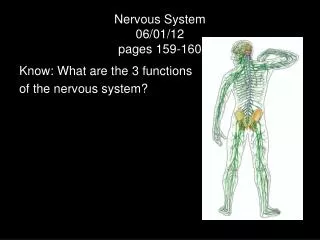
Nervous System06/01/12pages 159-160 Know: What are the 3 functions of the nervous system?
Receiving info – inside and outside body • Responding to info – reaction tostimulus(change/signal) • Maintaining homeostasis Neurons(nerve cells) carry nerve impulses(electrical or chemical messages) Functions Process
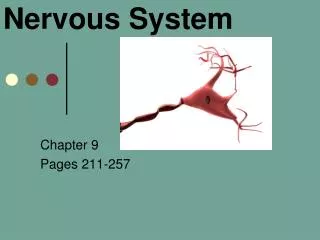
Impulses begin in dendrite, move toward cell body, then down axon. Carries impulse toward cell body Carries impulse away from cell body (Draw picture/label below) Process Dendrite Axon
Brain receives message and sends impulses to muscles. Impulses are passed from one nerve to another or to an organ through chemicals that jump the synapse(gap between nerve cells) Process
Types Reflex • Central–control center of body, brain and spinal cord • Peripheral – carries impulses between central nervous system and rest of body • Somatic nervous system – controls voluntary actions (texting) • Autonomic n.s. – controls involuntary actions (heart beat) Automatic involuntary response to danger. Ex: your arm pulls back if you touch something hot