Nonparametric Procedures
Nonparametric procedures, also known as distribution-free methods, do not require assumptions about the underlying data distribution. They are more robust than parametric tests (like t-tests) when data is non-normal, but can be less powerful if parametric conditions are met. This guide covers crucial nonparametric tests, focusing on the Wilcoxon Signed-Rank Test for one-sample median inference and the Wilcoxon Rank-Sum Test for two-sample comparisons. These tests rank data values to derive test statistics.

Nonparametric Procedures
E N D
Presentation Transcript
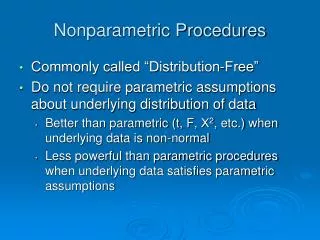
Nonparametric Procedures • Commonly called “Distribution-Free” • Do not require parametric assumptions about underlying distribution of data • Better than parametric (t, F, Χ2, etc.) when underlying data is non-normal • Less powerful than parametric procedures when underlying data satisfies parametric assumptions
Nonparametric Procedures • Hypotheses tests follow the same general procedure as for parametric procedures. • Set up appropriate hypothesis, typically for median instead of mean
One-Sample Inference on Median • Wilcoxon Signed-Rank Test • For this test, the absolute value of the centered data values |xi-m0| are ranked. • The appropriate sign is then attached to the rank of each absolute difference, (xi-m0). • (Note: If the medians (means) are the same, then the sum of the "signed ranks" should be near 0.) • Test Statistic: the sum of the ranks associated with the positive (xi-m0)
Wilcoxon Signed-Rank Test • Test Statistic: s+ = the sum of the ranks associated with the positive (xi-m0) • Rejection region defined by critical values c1 andc2 which can be obtained from Table A.13 • H1: m > m0 has rejection region s+ c1 • H1: m < m0 has rejection region s+ c2 • H1: m m0 has rejection region s+ c1 ors+ c2 • where c2 = n(n+1)/2 – c1
Wilcoxon Signed-Rank Test • Large Sample • For n>20, s+ is approximately normal in distribution with mean n(n+1)/4 and variance n(n+1)(2n+1)/24, so appropriate Z test can be used:
Two-Sample Inference on Median • Wilcoxon Rank-Sum (Mann-Whitney) Test • Based on the assumptions • Data from two independent random samples from continuous distributions with medians m1 and m2. • Distributions have same shape and spread. • Combined samples are ranked • Test Statistic: w = the sum of the ranks in the combined sample associated with population 1
Wilcoxon Rank-Sum Test • Test Statistic: w = the sum of the ranks in the combined sample associated with population 1 • Rejection region defined by critical values c1 andc2 which can be obtained from Table A.13 • H1: m1 > m2 has rejection region w c1 • H1: m1 < m2 has rejection region wc2 • H1: m1 m2 has rejection region w c1 orw c2 • where c2 = n1(n1+n2+1) – c1
Wilcoxon Rank-Sum Test • Large Sample • For n1>8 and n2>8, wis approximately normal in distribution with mean n1(n1+n2+1) / 2 and variance n1n2 (n1+n2+1) / 12 , so appropriate Z test can be used: