Download
1 / 1
10 likes | 114 Views
This study examines mathematical fact retrieval in dyslexic postsecondary students compared to control students. Results show difficulties in fast fact retrieval but no difference in error rates. Implications for academic support and guidance are discussed.

E N D
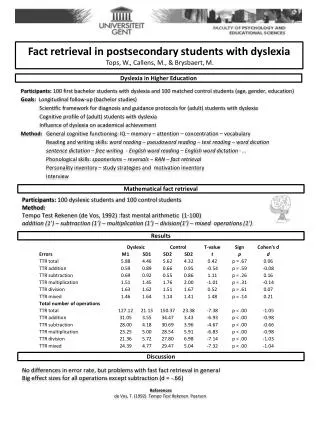
Dyslexia in Higher Education Fact retrieval in postsecondary students with dyslexiaTops, W., Callens, M., & Brysbaert, M. Mathematical fact retrieval • Participants:100 dyslexic students and 100 control students • Method: • Tempo Test Rekenen (de Vos, 1992) :fast mental arithmetic (1-100) • addition (1’) – subtraction (1’) – multiplication (1’) – division(1’) – mixed operations (1’) Results Participants: 100 first bachelor students with dyslexia and 100 matched control students (age, gender, education) Goals: Longitudinal follow-up (bachelor studies) Scientific framework for diagnosis and guidance protocols for (adult) students with dyslexia Cognitive profile of (adult) students with dyslexia Influence of dyslexia on academical achievement Method: General cognitive functioning: IQ – memory – attention – concentration – vocabulary Reading and writing skills: word reading – pseudoword reading – text reading – word dication sentence dictation – free writing - English word reading – English word dictation - … Phonological skills: spoonerisms – reversals – RAN – fact retrieval Personality inventory – study strategies and motivation inventory Interview Discussion No differences in error rate, but problems with fast fact retrieval in general Big effect sizes for all operations except subtraction (d = -.66) References de Vos, T. (1992). Tempo Test Rekenen. Pearson.