Skill Utilisation in UK and Australia: Insights for Policymakers and Business Leaders
This report explores skill utilisation in the UK and Australia, presenting insights from Chris Warhurst at the Labour Market Forum 2012. It identifies key factors affecting skill implementation, including job design, employee engagement, and effective leadership. This work highlights the interconnectedness of business development, organisational development, and workforce development while offering actionable policy recommendations. By understanding the triggers, deliverers, enablers, and outcomes, policymakers can address complexity and enhance both employer and employee benefits, ultimately supporting economic recovery and growth.

Skill Utilisation in UK and Australia: Insights for Policymakers and Business Leaders
E N D
Presentation Transcript
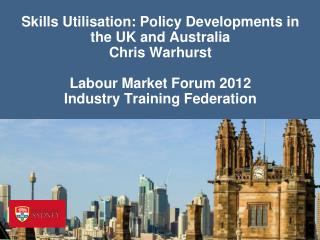
Skills Utilisation: Policy Developments in the UK and AustraliaChris WarhurstLabour Market Forum 2012Industry Training Federation
Developmental map Skill utilisation taps the potential T1 & T2 Supply Demand Definitional problem AWPA links WD, OD & BD Proxy: HPWS Inductive Triggers Deliverers Enablers Outcomes AMO UBS/BUS
Lessons • Policymakers don’t need to fear, instead can tackle complexity. Ambition and thoroughness pays dividends (not to say understanding can’t be further developed – iterative process). • Current understanding: • Triggers: product strategy but also regulation, labour markets. • Deliverers: job design, employee participation, skill audits etc. • Enablers : leadership & management, good HR practices; unions too. • Outcomes: aligning employer & employee gains important • Key point #1: business development (BD), organisational development (OD) and workforce development (WD) are linked. • Key point #2 next steps? Multiple points of policy leverage: • Leadership & management: leaders’ signal reading & sending; (middle/front-line) managers being implementation friendly. • Job quality: better job quality has national, firm and individual benefits; salvation for ailing economies, justification for sustained economies.