Mastering Addition and Subtraction of Mixed Numbers: A Step-by-Step Guide
This instructional guide aims to help students learn the addition and subtraction of mixed numbers. The process includes identifying the least common denominator (LCD), adjusting numerators, performing addition or subtraction with numerators, and simplifying the final result. The guide outlines essential steps to ensure students understand how to combine whole numbers and fractions effectively. Through engaging examples, learners will practice solving problems like 4 2/3 - 2 1/3 and 12 1/4 + 3 5/6, ensuring mastery of the concept.

Mastering Addition and Subtraction of Mixed Numbers: A Step-by-Step Guide
E N D
Presentation Transcript
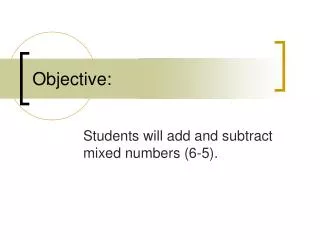
Objective: Students will add and subtract mixed numbers (6-5).
Vocabulary: • None
Steps: • Read all directions!!!!! • Write down the problem. • Find the LCD when needed. • Find your new numerators. • Add or subtract your numerators. • Keep same denominator. • Add or subtract your whole #’s. • Simplify.
Examples Find 4 2/3 – 2 1/3 Subtract the fractions 4 2/3 - 2 1/3 1/3
Examples Find 4 2/3 – 2 1/3 Subtract the subtract the fractions whole numbers 4 2/3 4 2/3 - 2 1/3- 2 1/3 1/3 2 1/3
Examples Find 12 ¼ + 3 5/6 Find equivalent fractions 12 ¼ 12 3/12 + 3 5/6+ 3 10/12
Examples Find 12 ¼ + 3 5/6 Find equivalent Add the fractions fractions 12 ¼ 12 3/12 12 3/12 + 3 5/6+ 3 10/12+ 3 10/12 13/12
Examples Find 12 ¼ + 3 5/6 Find equivalentAdd the Add the fractions fractions whole #s 12 ¼ 12 3/12 12 3/12 12 3/12 + 3 5/6+ 3 10/12+ 3 10/12+ 3 10/12 13/12 15 13/12
Examples Find 12 ¼ + 3 5/6 Find equivalentAdd theAdd the fractions fractions whole #s 12 ¼ 12 3/12 12 3/12 12 3/12 + 3 5/6+ 3 10/12+ 3 10/12+ 3 10/12 13/12 15 13/12 15 + 1 1/12 = 16 1/12Rename 13/12 as 1 1/12.
Examples Evaluate x – y if x = 5 9/10 and y = 2 ½. x – y = 5 9/10 – 2 ½The LCM of 2 & 10 is 10.
Examples Evaluate x – y if x = 5 9/10 and y = 2 ½. x – y = 5 9/10 – 2 ½ The LCM of 2 & 10 is 10. = 5 9/10 – 2 5/10 Rename 2 ½ as 2 5/10
Examples Evaluate x – y if x = 5 9/10 and y = 2 ½. x – y = 5 9/10 – 2 ½ The LCM of 2 & 10 is 10. = 5 9/10 – 2 5/10 Rename 2 ½ as 2 5/10 = 3 4/10 or 3 2/5 remember to simplify
Examples Find the perimeter of the triangle. 6 ¾ in. 2 ½in 7 1/8 in. P= 2 ½ + 6 ¾ +7 1/8The LCM of 2,4, and 8 is 8.
Examples Find the perimeter of the triangle. 6 ¾ in. 2 ½in 7 1/8 in. P= 2 ½ + 6 ¾ +7 1/8 The LCM of 2,4, and 8 is 8. P= 2 4/8 + 6 6/8 + 7 1/8Rename ½ as 4/8 & ¾
Examples Find the perimeter of the triangle. 6 ¾ in. 2 ½in 7 1/8 in. P= 2 ½ + 6 ¾ +7 1/8 The LCM of 2,4, and 8 is 8. P= 2 4/8 + 6 6/8 + 7 1/8 Rename ½ as 4/8 & ¾ P = 4+6+1 +2+6+7Add the fractions. Then add 8 the whole numbers.
Examples Find the perimeter of the triangle. 6 ¾ in. 2 ½in 7 1/8 in. P= 2 ½ + 6 ¾ +7 1/8 The LCM of 2,4, and 8 is 8. P= 2 4/8 + 6 6/8 + 7 1/8 Rename ½ as 4/8 & ¾ P = 4+6+1 +2+6+7 Add the fractions. Then add 8 the whole numbers. P = 11/8 +15
Examples Find the perimeter of the triangle. 6 ¾ in. 2 ½in 7 1/8 in. P= 2 ½ + 6 ¾ +7 1/8 The LCM of 2,4, and 8 is 8. P= 2 4/8 + 6 6/8 + 7 1/8 Rename ½ as 4/8 & ¾ P = 4+6+1 +2+6+7 Add the fractions. Then add 8 the whole numbers. P = 11/8 +15 P = 15 11/8 or 16 3/8 Rename 11/8 as 1 3/8. 15 + 1 3/8 = 16 3/8