Understanding Earth's Nutrient Cycles: The Interconnectedness of Water, Carbon, and Nitrogen
This resource explores the intricate relationships between Earth’s four spheres—atmosphere, hydrosphere, lithosphere, and biosphere—through the water, carbon, and nitrogen cycles. Learn how water vapor condenses, precipitates, and flows, how carbon is exchanged in various forms, and the essential roles that nitrogen fixation and decomposition play in maintaining ecosystem health. The cycles demonstrate the important interactions between living organisms and their environment, highlighting our dependence on these processes for life, food, and clean water.

Understanding Earth's Nutrient Cycles: The Interconnectedness of Water, Carbon, and Nitrogen
E N D
Presentation Transcript
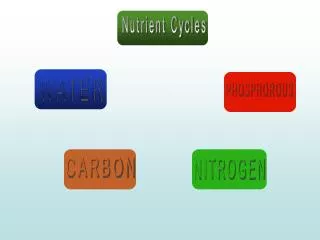
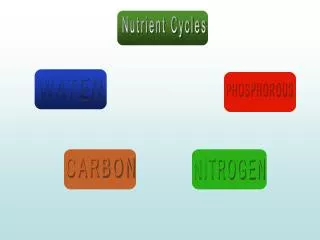
Nutrient Cycles CARBON WATER NITROGEN PHOSPHOROUS
Earth’s 4 Spheres air life water earth/rocks
The Water Cycle Condensation Evaporation Precipitation Transpiration Runoff Groundwater Human Uses Human Waste
Evaporation • Water that rises from the earth (lithosphere or biosphere) into the atmosphere
Condensation • Water in the atmosphere that clumps together to form clouds
Precipitation • Water that falls from the atmosphere to the earth (lithosphere)
Runoff • Water on the earth (lithosphere) that flows into bodies of water (hydrosphere)
Human Uses • We need water to live • For our bodies • To clean our food and ourselves
Human Waste • Animals (including humans) return water to ground and bodies of water through urine
Groundwater • Water stored in the lithosphere
The Carbon Cycle Pollution Photosynthesis Gas Exchange Carbon Fixation Gas Exchange Burning Fossil Fuels Animal Waste Decomposition Fossilization
Gas Exchange • CO2 exchanges between water and the atmosphere • dissolves from the atmosphere into water (the hydrosphere) • rises out of water into the atmosphere
Photosynthesis • Plants use CO2 from the atmosphere to make glucose sugar (C6H12O6)
Carbon Fixation • When CO2 leaves the atmosphere and enters the biosphere (usually photosynthesis)
Animal Waste • Carbon compounds are released through solid waste into land and water (the lithosphere and hydrosphere)
Decomposition • Carbon is decomposed (by bacteria and other decomposers) into soil
Fossilization • When plants and animals die, the carbon in their bodies may be turned into fossil fuels • Under the right heat and pressure
Burning Fossil Fuels • We can burn these fossils and use the energy from them as fuel (coal, oil, and natural gas) • CO2 is released when they are burnt
Pollution • CO2 from the burnt fuels is released back into the atmosphere
The Nitrogen Cycle Burning Fossil Fuels Animal Use De-nitrification Nitrogen Fixation Waste Runoff Plant Use
Nitrogen Fixation • Lightning and bacteria put atmospheric nitrogen into the lithosphere and hydrosphere (NO3 and NH3)
Plant Use • Plants use nitrogen to make amino acids (the building blocks of proteins!) • From the atmosphere to the biosphere
Animal Use • Animals break apart the plant proteins and use the amino acids to build their own proteins • Stays in the biosphere
Waste • Decomposers break down animals and plant matter into nitrogen for the soil (lithosphere and biosphere)
De-nitrification • Decomposers turn nitrogen compounds back into nitrogen gas (lithosphere to atmosphere)
Runoff • Runoff washes nitrogen from the ground into water (lithosphere into the hydrosphere)
Burning Fossil Fuels • Nitrogen enters the atmosphere as pollution from our factories • Lithosphere to atmosphere
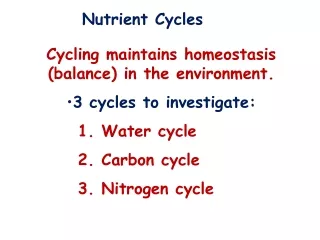
Question 1: Explain how the Earth’s 4 spheres are connected through the water, carbon, and nitrogen cycles.
Analysis: Yosemite National Park was my grandfather’s favorite place on earth. When he died, we spread some of his ashes there. Draw and label the path of a CARBON atom from Ms. Macway’s Grandpa’s remains to where it could become part of a hawk. Note: A hawk is a carnivore, but it did NOT dig up and consume my Grandpa’s remains!!!