Induction of Polycystic Ovary Syndrome in NMRI Mice Using Testosterone Enantate
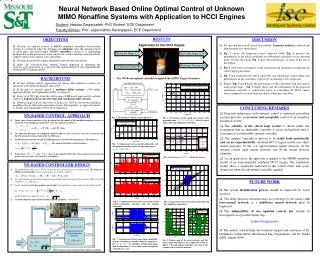
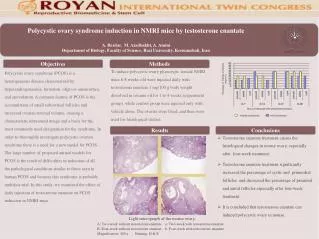
This study aimed to induce the polycystic ovary phenotype in female NMRI mice aged 6-8 weeks via daily injections of testosterone enantate (1 mg/100 g body weight) dissolved in sesame oil for 1 to 4 weeks. The results indicated that testosterone enantate treatment led to significant histological changes in mouse ovaries, including an increased percentage of cystic and primordial follicles and a decrease in preantral and antral follicles, particularly after four weeks of treatment. This suggests that testosterone enantate effectively induces polycystic ovary syndrome in mice, providing a new model for further investigation.

Induction of Polycystic Ovary Syndrome in NMRI Mice Using Testosterone Enantate
E N D
Presentation Transcript
Polycystic ovary syndrome induction in NMRI mice by testosterone enantate A. Bazdar, M. Azadbakht, A. Amini Department of Biology, Faculty of Science, Razi University, Kermanshah, Iran Objectives Methods To induce polycystic ovary phenotype, female NMRI mice 6-8 weeks-old were injected daily with testosterone enantate 1 mg/100 g body weight dissolved in sesame oil for 1 to 4 weeks (experiment group), while control group were injected only with vehicle alone.The ovaries were fixed, and then were used for histological studies. Polycystic ovary syndrome (PCOS) is a heterogeneous disease characterized by hyperandrogenaemia, hirsutism, oligo-or amenorrhea, and anovulation. A common feature of PCOS is the accumulation of small subcortical follicles and increased ovarian stromal volume, causing a characteristic ultrasound image and a basis for the most commonly used designation for the syndrome. In order to thoroughly investigate polycystic ovarian syndrome there is a need for a new model for PCOS. The large number of proposed animal models for PCOS is the result of difficulties in induction of all the pathological conditions similar to those seen in human PCOS and because this syndrome is probably multifactorial. In this study, we examined the effect of daily injection of testosterone enantate on PCOS induction in NMRI mice. Results Conclusions • Testosterone enantate treatment causes the histological changes in mouse ovary, especially after four-week treatment. • Testosterone enantate treatment significantly increased the percentage of cystic and primordial follicles and decreased the percentage of preantral and antral follicles especially after four-week treatment. • It is concluded that testosterone enantate can induced polycystic ovary in mouse. A B b a Light micrograph of the mouse ovary. A: Two-week without testosterone enantate a: Two-week with testosterone enantate B: Four-week without testosterone enantate b: Four-week with testosterone enantate Magnification: 400 x Staining: H & E