Introduction to Animals
This chapter explores what defines animals as multicellular, heterotrophic organisms capable of movement, sexual reproduction, and development. It delves into the concepts of body symmetry, including radial, bilateral, and asymmetry, explaining their significance in the animal kingdom. Additionally, the text outlines the distinctions between vertebrates and invertebrates, highlighting the structure and function of the notochord in chordates. The chapter also covers the processes of embryonic development, including cleavage, blastula formation, gastrulation, and the formation of germ layers (ectoderm, mesoderm, endoderm), which give rise to various body systems.

Introduction to Animals
E N D
Presentation Transcript
Introduction to Animals Chapter 34
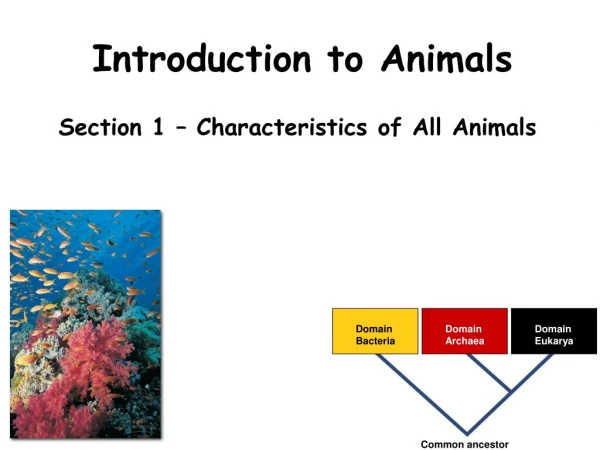
What makes ananimal an animal? • Multicellular • Heterotrophy • Sexual reproduction & development • Movement
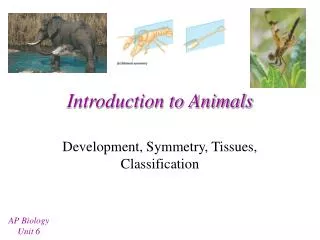
Body Symmetry • Radial symmetry- a body plan in which the parts are organized in circle around an axis.
Body Symmetry • Bilateral symmetry- two similar halves on either side of a central plane
Body Symmetry • Asymmetry- no organization
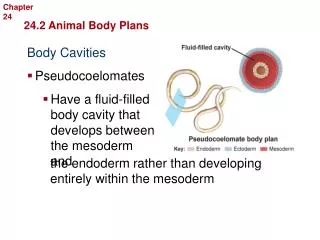
Body Cavity • Body cavity- fluid filled space that forms between the digestive tract and the outer wall of the body. • Aids in movement and acts as a reservoir and medium of transport for nutrients and wastes.
Animal Kingdom Invertebrates Vertebrates Animals with a Backbone or Spinal Column: (All these animals are in the phyla Chordata and the subphyla Vertebrata.) • Animals without a Backbone or Spinal Column
Vertebrates • Vertebrates are a subphylum of chordates. • Chordates comes from notochord which is a firm, flexible rod of tissue located in the dorsal part of the body. • In vertebrates the notochord develops into a brain and spinal cord.
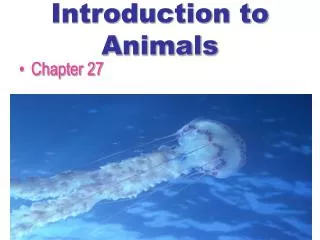
Invertebrates • Most invertebrates have bilateral symmetry which is an adaptation to a more motile lifestyle. • It allows for cephalization. • Radial symmetry are not very motile and drift along, allows for more access to food sources.
Cell to Embryo Cleavage- the series of cell divisions that occurs immediately following fertilization Blastula- dividing cells become a hollow ball Gastrulation- transforms the blastula into a multilaytered embryo called the gastrula
Germ Layers • Ectoderm- outer layer of the gastrula • Forms the outer layer of skin, hair, nails and the nervous system • Mesoderm- middle layer • Forms the skeleton, muscles, inner layer of skin, circulatory system and the lining of the body cavity • Endoderm- inner layer • Forms the urinary and reproductive systems, and the digestive tract; pancreas, liver, lungs and gills