Western Larch
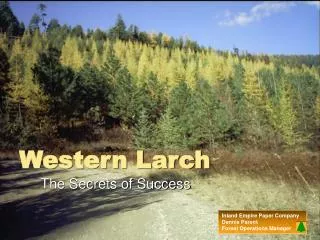
Western Larch. The Secrets of Success. Inland Empire Paper Company Dennis Parent Forest Operations Manager. Summary. Review silvics of larch Review larch silvicultural treatments My “Secrets” of growing larch. Silvics of Western Larch.

Western Larch
E N D
Presentation Transcript
Western Larch The Secrets of Success Inland Empire Paper Company Dennis Parent Forest Operations Manager
Summary • Review silvics of larch • Review larch silvicultural treatments • My “Secrets” of growing larch
Silvics of Western Larch • Western Larch: a “deciduous conifer in an evergreen world”
Silvics of Western Larch • Silvics of North America Available on the Internet: “Silvics of North American Trees”
Silvics of Western Larch Silvics of Western Larch Silvics of Western Larch • 10 species total • Three species in U.S. • Western larch • (Larix occidentalis) • Subalpine larch • (Larix lyallii) • Eastern larch • (Larix laricina) • The tallest and the largest of the world’s larches • A seral species
Comparative Shade Tolerance of Northwestern Conifers
Silvics of Western Larch • Growth • Fastest growing species in Inland Northwest • Diameter growth very sensitive to stand density • Develops into even-aged stands • Height growth both predetermined and free
Silvics of Western Larch • Fire resistant • Wind firm • Tolerates root rot • Tolerates soils with poor nutrition • Wood is hard, strong, and dense.
Silvics of Western Larch Insects, Diseases, Etc.
Insects & Diseases Mistletoe
Insects & Diseases Larch casebearer
Insects & Diseases Needle cast
Insects & Diseases Bears
Insects & Diseases Spruce budworm Heart rot Beetles, a recent phenomenon
Silvics of Western Larch • Cones & seed • Flowers very early • One of the best seed producers in northwest Montana • One of the worst seed producers in northern Idaho
Silvics of Western Larch • Genetics • Seed transfer is relatively broad • Adaptability intermediate between white pine and ponderosa pine
Silvics of Western Larch • Larch nutrition • Little information • High nitrogen use efficiency • Effectively translocates nitrogen
Silvics of Western Larch • Water use • Less efficient than other conifers • Avoids winter desiccation
Silvics of Western Larch • Carbon fixation • Efficient crown architecture • Small, short branches • Photosynthetic rate similar on a leaf area basis • Photosynthetic rate greater on leaf weight basis • Result: Larch fixes the same amount of carbon as other conifers
Silvics of Western Larch • Watershed values • Little snow interception • Higher water yield • Higher melt rates from ROS
Silvics of Western Larch • Aesthetics • Color diversity • Beautiful landscapes
Special Problems of Western Larch • Needs adequate site preparation • Losses crown quickly if overtopped • Susceptible to herbicides • Poor seed yields • Foresters and loggers!
Special Strengths of Western Larch • Fire resistant • Favored by wildfire
Special Strengths of Western Larch • Fire resistant • Favored by wildfire • Resistant to root rot
Relative Susceptibility of Inland Northwest Conifers to Root Disease
Special Strengths of Western Larch • Fire resistant • Favored by wildfire • Resistant to root rot • Genetic adaptability
Potential for Genetic Improvement of Inland Species • Genetic Characteristics of Western Larch • Highest potential gain in volume through genetic improvement: 20-40 percent • Higher value species • Fastest growth • Poor natural seed yields • Easy to graft • Seed transfer is relatively broad • Responds to intensive management
Special Strengths of Western Larch • Fire resistant • Favored by wildfire • Resistant to root rot • Genetic adaptability • Strong wood
Special Strengths of Western Larch • Fire resistant • Favored by wildfire • Resistant to root rot • Genetic adaptability • Strong wood • Fast juvenile growth • Wind firm • Resists snow and ice loading • Good long-lived snag species • Arabinogalactan
Silvicultural Treatments • Natural Regeneration • Good site preparation
Silvicultural Treatments • Natural Regeneration • Predict cone crop
Silvicultural Treatments • Natural Regeneration • Enhance seed production by girdling
Silvicultural Treatments • Artificial Regeneration • Good site preparation = good survival
Silvicultural Treatments • Artificial Regeneration • Plant seedlings as large as you can afford.
Silvicultural Treatments • Artificial Regeneration • Spring vs. fall plant
Silvicultural Treatments • Vegetation control • Do it before planting!
For this Instead of this
Silvicultural Treatments • Vegetation control • Oust herbicide may work
Silvicultural Treatments • Density control • Principles of thinning • Concentrate growth on fewer stems • Decrease total stand growth • Increase merchantable stand yield • Total stand cubic foot yields are not increased.
Silvicultural Treatments • Precommercial thinning • Watch out for: • High costs = poor investment
Silvicultural Treatments • Density control
Silvicultural Treatments • Density control • Precommercial thin but watch for: • High costs = poor investment • Trees getting too big • Thinning too late => crown loss
Silvicultural Treatments • Density control • PCT conclusions • Thin early • Thin from below • Select spacing carefully
Silvicultural Treatments • Density control • Commercial thinning – some problems • Opens up stand to brush competition • Stand growth loss • Larger trees are not worth more money today.
Silvicultural Treatments • Density control • Other objectives for commercial thinning • Growing large diameter trees • Structural and vegetation diversity • Aesthetics • Earlier income generation • Perpetuate culmination of MAI
Silvicultural Treatments • Density control • Affect of thinning on wood strength • Not ring width, but summerwood/springwood ratio • Thinning can increase summerwood/springwood ratio • Thinning does not decrease wood strength • Young, managed larch has similar wood density levels as those found in natural stands. • This is not true for other western conifers!
Silvicultural Treatments • Pruning • Not necessary and probably a waste of money • Natural self-pruning • Epicormic branching • Dimension lumber; 1-2” knots acceptable
Silvicultural Treatments • Nutrition & fertilization • Little information available • Castille, 1983: Two-year growth • Filip and Oester, 2002: Ten-year growth • Graham, 1986: Effect on cone and seed production • IFTNC: Field trials on Boise Cascade lands • No firm conclusions for larch