Science Project
Science Project. By: Paige Paulson. Lithosphere. Lithosphere is the crust and the rigid part of Earth’s mantle. The mantle below the lithosphere is very hot. Plate tectonics explains how the continents and the ocean floor move.

Science Project
E N D
Presentation Transcript
Science Project By: Paige Paulson
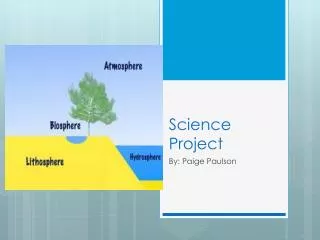
Lithosphere • Lithosphere is the crust and the rigid part of Earth’s mantle. • The mantle below the lithosphere is very hot. • Plate tectonics explains how the continents and the ocean floor move. • Continental drift is the slow movement of the continents over eons. • Pangaea was named by Wegener and is a supercontinent. • Volcanism is the relationship of volcanic activity.
Hydrosphere • Hydrosphere is the part of Earth that contains water. • Water covers about 75 percent of Earth. • Water exists in many forms and many places. • Water Cycle is the movement of water between Earth’s surface and air. • Precipitation is water that falls from clouds to the ground. • Aquifers are an underground rock and soil filled with water squeezed between packed rock.
Atmosphere • Atmosphere is the layers of gases that surrounds Earth. • Air is the most primary things that make Earth life possibly. • The atmosphere gases are oxygen, nitrogen, and argon. • Relationship between pressure and height if the place is high the pressure is high and the same with low pressure and height. • Layers of the atmosphere are Exosphere, Thermosphere, Mesosphere, Stratosphere, and Troposphere. • Ozone layer location is in the lower portion of the Stratosphere.
Biosphere • Biosphere is all about life. • Is when one place where all of the spheres of the planet work together. • It extends to any place that life can exist. • Components are fungi, plant, and animals. • Food Chain is when food goes from one organism to another. • Ecosystems includes all of the living organisms.
Sphere Interaction • River action erodes banks (Lithosphere) and uproots plants (Biosphere) on the riverbanks. • Rainfall (Hydrosphere) increases after a volcanic eruption, which stimulates plant growth (Biosphere). • The particles of matter in the air (Atmosphere) falls out, killing plants (Biosphere). • Living things (Biosphere) need water (Hydrosphere) and air (Atmosphere) to survive. • Climate (Atmosphere) affects weathering and erosion of rocks (Lithosphere). • The very warm ocean waters(Hydrosphere) warm the air (Atmosphere) above them and evaporates the water.