Download

1 / 39
400 likes | 550 Views
This review covers significant aspects of early civilizations, from the nomadic Paleolithic Age to the transformative Neolithic Revolution around 10,000 B.C. It highlights the emergence of farming, the development of permanent settlements, and complex societies such as the Sumerians in Mesopotamia, the Egyptian Empire, and the Shang Dynasty in China. Key achievements like the Code of Hammurabi, hieroglyphics, and the Mandate of Heaven are discussed, alongside natural barriers that influenced trade and settlement patterns. Essential for understanding the foundations of human civilization.

E N D
Paleolithic Age - Men and women of the Paleolithic Age were nomads.
They live in bands of no more than 2-3 dozen people. SMALL GROUPS
2. Neolithic Revolution10,000 B.C. • Discovery of farming/and the domestication of animals
4. Permanent Settlements Steady Food Source Increase in Population New Technology New Cultural Developments More Complex Society
7. Sumerians are the first civilization to develop in Mesopotamia. 3,300 B.C.
9. Code of Hammurabi: First set of written laws created by King Hammurabi to unify the laws throughout an empire.
10. Egyptian Empire was surrounded by deserts (Eastern and Western Desert).
11. Positive--Kept invaders out. NATURAL BARRIER!
12. Egyptians traded with Sumerians and Nubians
13. Hieroglyphics—system of writing using pictures and symbols. *culturally diffused from Sumerian Cuneiform
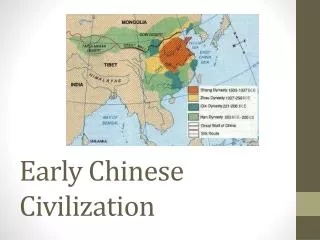
14. Shang Dynasty-∙1st dynasty to leave written records.
15a.Mandate of Heaven—theory that it is justified to overthrow a bad government with the approval of the gods. B. Started by the Zhou Dynasty
16. Two major river systems are:1. Yangtze River (AKA—Chang Jiang)2. Huang He(AKA—Yellow)
17. Chinese called themselves the“Middle Kingdom”a. thought they were the center of the civilized world
19.Natural barriers between India and the rest of the Asian continent: 1. Himalaya Mountains 2. Thar Desert 3. Hindu Kush Mountains 4. Karakoram Mountains
20. China’s natural barriers:1. Gobi Desert2.Taklamakan Desert3. Plateau of Tibet4. Himalaya Mountains
21. Natural Barriers provide protection by keeping out invaders.
22. Common features:*developed on rivers*transportation*trade*irrigation*silt/fertile soil*polytheistic*system of writing
23. Rivers provided:*transportation*trade*irrigation*silt/fertile soil
Code of Hammurabi: first set of written laws A. An for an .
Egyptian Contributions and Achievements: 1. Hieroglyphics—system of writing using pictures and symbols.
Papyrus—paper made from reeds that grew in the marshy Nile delta.
Pyramids—tombs for pharaohs Pyramids at Giza
Pharoahs—Egyptian God- Kings Theocracy—Gov’t in which the ruler is believed to be a god or a representative of the god(s).
Indus Contributions/Achievements:A. City building:1. Kalibangan 2. Mohenjo-Daro 3. Harappa
YellowContributions/Achievements:*Mandate of Heaven—theory that it is justified to overthrow a bad government with the approval of the gods.