Download
1 / 17
170 likes | 257 Views
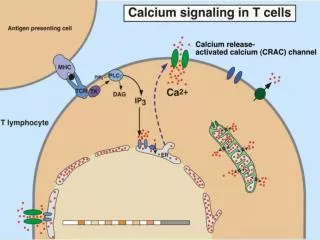
Explore the early rise in intracellular calcium levels upon TCR engagement and its critical role in T cell activation. Learn about the pharmacological and genetic evidence supporting this process, as well as the signaling pathways involved in calcium release and entry. Understand the requirements for calcium signal duration and amplitude, and the impact on TCR-responsive gene expression. Discover the cooperative nature of IP3-induced calcium release and the involvement of CRAC channels in TCR-triggered calcium entry.

E N D
Engagement of the TCR causes an early rise in [Ca2+]i Population response Tsien et al, 1982 Single-cell response (FACS)
Single-cell responses (imaging) Negulescu et al, 1996
The [Ca2+]i rise is necessary for T cell activation I. Pharmacological evidence Chung et al, 1994
Le Diest et al, 1995 The [Ca2+]i rise is necessary for T cell activation II. Genetic evidence
The [Ca2+]i rise (with PKC activation) is sufficient to induce TCR-responsive genes Diehn et al, 2002
Duration and amplitude requirements for the Ca2+ signal Dolmetsch et al, 1998 Negulescu et al, 1994
Generation of the Ca2+ signal by antigen recognition I. IP3-induced Ca2+ release Winslow et al, 2003 IP3 Imboden & Stobo, 1985
IP3-induced Ca2+ release is highly cooperative Jurkat cells IP3 receptors in planar lipid bilayer Bezprozvanny et al, 1991
TCR engagement triggers “capacitative” (store-operated) Ca2+ entry in lymphocytes Mason et al, 1991
Premack et al, 1994 TCR engagement stimulates Ca2+ entry via the CRAC channel Zweifach and Lewis, 1993
CRAC channels are the sole Ca2+ entry pathway triggered through the TCR mutagenize Jurkat NFAT/dipA Ca Ca X dipA survival Ionomycin + PdBU Fanger et al, 1995 (Also see Partiseti et al, 1994; Feske et al, 2001)