
Data Mining
E N D
Presentation Transcript
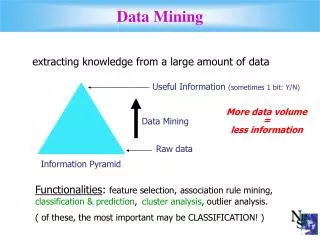
Data Mining • The process of extracting valid, previously unknown, comprehensible, and actionable information from large databases and using it to make crucial business decisions, (Simoudis,1996). • Involves the analysis of data and the use of software techniques for finding hidden and unexpected patterns and relationships in sets of data.
Data Mining • Reveals information that is hidden and unexpected, as little value in finding patterns and relationships that are already intuitive. • Patterns and relationships are identified by examining the underlying rules and features in the data. • Data mining can provide huge paybacks for companies who have made a significant investment in data warehousing. • Relatively new technology, however already used in a number of industries.
Examples of Applications of Data Mining • Retail / Marketing • Identifying buying patterns of customers • Finding associations among customer demographic characteristics • Predicting response to mailing campaigns • Market basket analysis • Banking • Detecting patterns of fraudulent credit card use • Identifying loyal customers • Predicting customers likely to change their credit card affiliation • Determining credit card spending by customer groups
Examples of Applications of Data Mining • Insurance • Claims analysis • Predicting which customers will buy new policies • Medicine • Characterizing patient behavior to predict surgery visits • Identifying successful medical therapies for different illnesses
Data Mining Operations • Four main operations include: • Predictive modeling • Database segmentation • Link analysis • Deviation detection
Database Segmentation • Aim is to partition a database into an unknown number of segments, or clusters, of similar records. • Uses unsupervised learning to discover homogeneous sub-populations in a database to improve the accuracy of the profiles. • Less precise than other operations thus less sensitive to redundant and irrelevant features. • Sensitivity can be reduced by ignoring a subset of the attributes that describe each instance or by assigning a weighting factor to each variable. • Applications of database segmentation include customer profiling, direct marketing, and cross selling.
Data Mining and Data Warehousing • Major challenge to exploit data mining is identifying suitable data to mine. • Data mining requires single, separate, clean, integrated, and self-consistent source of data. • A data warehouse is well equipped for providing data for mining. • Data quality and consistency is a pre-requisite for mining to ensure the accuracy of the predictive models. Data warehouses are populated with clean, consistent data.
Data Mining and Data Warehousing • It is advantageous to mine data from multiple sources to discover as many interrelationships as possible. Data warehouses contain data from a number of sources. • Selecting the relevant subsets of records and fields for data mining requires the query capabilities of the data warehouse. • The results of a data mining study are useful if there is some way to further investigate the uncovered patterns. Data warehouses provide the capability to go back to the data source.