Understanding Nuclear Proliferation and Détente During the Cold War Era
This exploration delves into nuclear proliferation, focusing on the sale and spread of nuclear weapons technology. It examines the concept of détente, particularly after the Cuban Missile Crisis, illuminating how the U.S. and Soviet Union sought to reduce tensions through treaties such as the Nuclear Test Ban Treaty in 1963 and the Strategic Arms Limitation Treaties (SALT). Despite these efforts, the Non-Proliferation Treaty of 1968 has seen limited success, with nations like North Korea withdrawing and economic sanctions proving insufficient in curbing nuclear ambitions.

Understanding Nuclear Proliferation and Détente During the Cold War Era
E N D
Presentation Transcript
Key Word: • nuclear proliferation: the sale and spread of nuclear weapons and nuclear weapons technology. • détente:the easing of tensions between two countries
I. Détente in the Cold War • After the Cuban Missile Crisis, both the U.S. and Soviet Union sought to ease tensions with a number of treaties. • In 1963, the Nuclear Test Ban Treatybanned nuclear testing in space, the atmosphere, and underwater. • In 1963, two SALT, or Strategic Arms Limitation Treaties attempted to limit each sides’ nuclear arsenal.
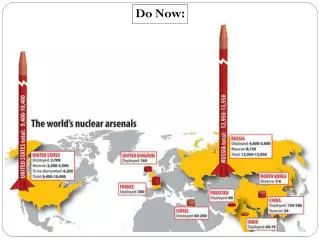
I. How Nuclear Weapons Proliferate • In some cases, countries develop nuclear weapons technology on their own. • In other cases, countries sell the technology to make nuclear weapons to other countries. • In an attempt to control this, the United Nations passed the Non-Proliferation Treaty in 1968. • However, the treaty has ultimately failed as only 190 out of 196 countries have signed on. • Others, like North Korea, have withdrawn from the treaty as well. • In an attempt to enforce the treaty, the United Nations often imposes economic sanctions as a way to get countries to abandon nuclear weapons programs, but often with limited success.