Download
1 / 5
50 likes | 161 Views
This vocabulary guide explores key concepts related to totalitarianism, dictatorship, and political ideologies that shaped World War II. It defines crucial terms such as communism, fascism, and Nazism, highlighting their implications on society and government. Additionally, it covers economic challenges like depression and inflation, along with acts of aggression, persecution, and genocide exemplified during the war, including the Holocaust. This comprehensive overview aids in understanding the historical context and the devastating effects of these ideologies.

E N D
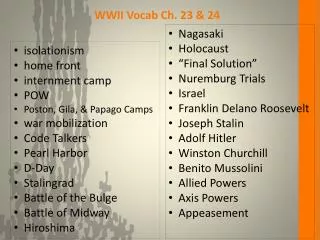
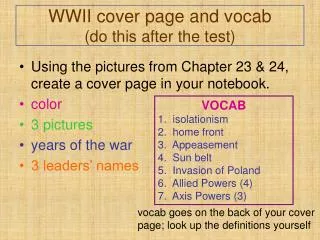
Copy Vocabulary • Totalitarianism – government control over every aspect of private and public life • Dictator – a leader with absolute power and no restrictions • Communism – economic system where everything is owned by the public; no private property • Fascism – belief that promotes extreme nationalism and militarism with a dictator • Command Economy – economy where the government makes all decisions
Copy Vocabulary • Depression – a long and severe recession in an economy • Nazism – fascist beliefs of the Nazi Party and a belief in racial superiority • Purge – to get rid of or cleanse what is undesirable • Scapegoat – person/people blames for others’ problems • Inflation – when prices increase but wages do not
Copy Vocabulary • Aggression – warlike act against a country without just cause • Appeasement – making concessions to an aggressor to avoid war • Ghetto – city neighborhoods where Jews were forced to live • Persecute – to harass or oppress certain groups of people • Anti-Semitism – discrimination against Jews
Copy Vocabulary • Blitzkrieg – lightning war; fast moving attacks • Genocide – deliberate and systematic extermination of a group of people • Holocaust – mass slaughter of European Jews by the Nazis • Rationing – limiting the amount/type of goods people can buy • Propaganda – material spread to support a cause or damage an opponent’s cause