Understanding Synaptic Transmission: Communication Between Neurons
This lesson covers the intricacies of synaptic transmission, exploring the communication between neurons through both electrical and chemical mechanisms. Topics include electrotonic conduction, ligand-receptor interactions, and the steps involved in synaptic events such as neurotransmitter release and binding. Learn about electrical synapses, the roles of connexons, calcium influx, and the modulation of neurotransmitter release. The lesson also addresses drug interactions and their effects on synaptic transmission, enhancing the understanding of neural communication in both health and disease.

Understanding Synaptic Transmission: Communication Between Neurons
E N D
Presentation Transcript
Synaptic Transmission Lesson 12
Synapses • Communication b/n neurons • Electrical • Electrotonic conduction • Chemical • Ligand / receptor ~
Electrical Synapses • Tight junctions • Connexons • Passive current • & larger molecules (e.g., ATP) • Synchronous activity • Breathing • Hormone release from hypothalamus ~
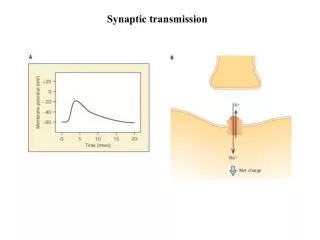
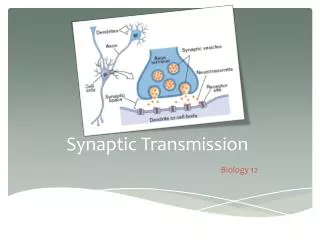
Synaptic Events • Action Potential reaches axon terminal • Chemical substance released • Neurotransmitter (NT) • Diffuses across synapse • Binds to receptor protein • EPSP or IPSP ~
Synaptic Transmission Model 1. Precursor transport 2. NT synthesis 3. Storage 4. Release 5. Activation 6. Termination ~
Postsynaptic Membrane Presynaptic Axon Terminal Dendritic Spine Terminal Button
1. Precursor Transport
2. Synthesis Enzymes & cofactors ~ E
3. Storage In vesicles Terminal Button Dendritic Spine Synapse
AP Ca++ 4. Release • via exocytosis • diffusion Synapse
Exocytosis: Membrane Fusion • Ca2+ influx • 2d messenger • Ca2+ -Calmodulin • SNAPs • soluble-NSF-attachment proteins • SNAREs • SNAP receptors ~
5. Activation • NT binds to receptor
Activation • NT binds to postsynaptic receptor • opens ion channel • EPSP • Na+ into cell • or IPSP • K+ out of cell ~
6. Termination • 4 Basic methods • Diffusion • Enzymatic degradation • Presynaptic reuptake • active transport • Autoreceptors ~
6. Termination • autoreceptors A
Autoreceptors • On presynaptic terminal • Binds NT • same as postsynaptic receptors • different receptor subtype • Decreases NT release & synthesis ~
Termination • Must have discrete signal • What if ion channels continually open? • ions move toward equilibrium • membrane no longer polarized • no EPSPs or IPSPs • Disrupts neural communication • Termination ---> neuron repolarizes ~
Axoaxonic Synapses • Modulation of NT release • *via or Ca2+ influx • Presynaptic Facilitation • Increases NT release • Presynaptic Inhibition • decreases NT release • Via modulation of Em • Ca2+, K+, and Cl- ~
Drug Interaction Terms • Drug’s effect on synaptic transmission • Direct at postsynaptic receptor • Indirect at any other step • Agonist (AG) • mimics or NT effects • Antagonist (ANT) • blocks or ¯NT effects ~