Improving Healthcare Delivery in the Western Isles: Strategies and Community Engagement
110 likes | 235 Views
This report outlines the Clinical Reference Group meeting held on March 25, 2008, focusing on the challenges and opportunities for remote and rural healthcare in the Western Isles. Led by key speakers, including John Turner and Martin Hill, the discussions covered the development of a clinical strategy aimed at improving health services over the next 3-5 years. Key themes included enhancing local care, integrating patient pathways, and utilizing telemedicine. Workshop sessions aimed to gather feedback on priorities and determine action areas for future healthcare improvement efforts in the region.


Improving Healthcare Delivery in the Western Isles: Strategies and Community Engagement
E N D
Presentation Transcript
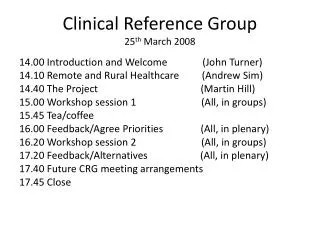
Clinical Reference Group25th March 2008 14.00 Introduction and Welcome (John Turner) 14.10 Remote and Rural Healthcare (Andrew Sim) 14.40 The Project (Martin Hill) 15.00 Workshop session 1 (All, in groups) 15.45 Tea/coffee 16.00 Feedback/Agree Priorities (All, in plenary) 16.20 Workshop session 2 (All, in groups) 17.20 Feedback/Alternatives (All, in plenary) 17.40 Future CRG meeting arrangements 17.45 Close
Western Isles – Clinical StrategyClinical Reference Group Current Stage – Scope/Emerging Themes Martin Hill Programme Director
The Project • Clinical strategy for the next 3-5 years • For the people of the Western Isles (all providers) • Deliver best practice/modern standards • Improve health and quality of life • Phase 1 - create vision/service model • Phase 2 – test vision through consultation • Process of engagement/open debate
The Challenges • Different models of care (on and off island) • Provide more care locally • Off-island referrals increasing • Workforce availability • High costs/inefficiency • Sustainability of current services • Resistance to change • Small and ageing population (and staff)
The Opportunities • Highly motivated workforce • Clinical networking (on and off island) • Telemedicine/e-health • Skills and role development • New providers • Stronger partnerships
Feedback from Project Launch • Lack of clarity about current services • Incoherent patient pathways • Services not sufficiently patient-focussed • Need reassurance about same chance of survival as someone on mainland • Poorly integrated emergency care • Want integrated community “hubs”/locally enhanced services
Feedback from Project Launch(2) • Make far more use of IT/telemedicine • Redesign resident v. visiting consultant services • Challenges of transport/travel • Want to retain access to mainland hospitals • Many premises not fit for purpose • Need better leadership
Identifying the Priorities • Hospital services:- • Specialty by specialty , best practice review • Activity and outcomes • Patient pathways – acute (investigation/referral/treatment/follow up) • Patient pathways – long term conditions (diagnostics/self/shared care/reduced admission) • Potential for clinical networking and shared care • Future challenges
Identifying the Priorities (2) • Primary and community based services:- • Extending primary care teams • Managing long term conditions • Wider use of protocols (emergency care, assessment/triage, referral, transport) • Extended partnerships (hospitals, local authority, voluntary services)
Workshop session 1 • What particular clinical service areas should we concentrate on for review, that are significant in terms of an overall clinical strategy (identify 6 – they can be individual specialties or wider service areas)? • Why these particular areas? • Who should lead/be involved in the initial review?
Workshop session 2 • Taking each of the top 3 service areas for initial review in turn, how would you describe the service, using a range of descriptors (e.g. patient pathway, use of beds, organisational structure) ? • Which data should be gathered/reviewed? • What alternative arrangements for each of these 3 service areas should be considered to improve the service and/or it’s sustainability?