Principles of Animation
620 likes | 1.35k Views
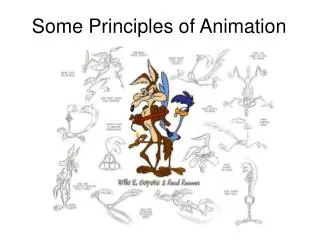
Squash and Stretch Timing Anticipation Staging Follow Through & Overlapping Action Straight Ahead Action and Pose to Pose Action. Slow In and Slow Out Arcs Exaggeration Secondary Action Appeal. Principles of Animation. Squash and Stretch Bouncing Ball Example.


Principles of Animation
E N D
Presentation Transcript
Squash and Stretch • Timing • Anticipation • Staging • Follow Through & Overlapping Action • Straight Ahead Action and Pose to Pose Action • Slow In and Slow Out • Arcs • Exaggeration • Secondary Action • Appeal Principles of Animation
Squash and StretchBouncing Ball Example The ball on the right moves at a constant speed with squash/stretch. The ball on the left moves at a constant speed with no squash/stretch. The ball in the center does slow in and out with a squash/stretch.
Timing • Relays the idea behind the action • Even spacing between frames = constant speed • Frames that are closer together are sped up. • Frames that are far apart slow down.
Anticipation • Action has three parts • Preparation for the action (anticipation) • Action itself • Termination of the action (follow through) • Need anticipation to: • Make actions natural • Muscle movement (kicking a ball) • Prepare audience for the following action • Direct attention to another part of the screen
Anticipation http://www.naptime.com/flash/principles/Cannon-06.html
Staging • Present the idea so it is unmistakably clear. • Audience can only see one thing at a time. • The setting and character position is very enlightening to the audience.
Follow through • Actions rarely come to sudden stops • There are leading parts, other participating parts and appendages • Action starts by leading part • Main action follows • Appendages continue to move longer • Heavy ones drag along longer
Follow Through • Audience likes to see resolution of action • Discontinuities are unsettling
Overlapping action • Add variations to timing of loose parts • Little extra actions make it more interesting • New action starts BEFORE previous one stops
Pose to Pose Action http://www.freetoon.com/prestonblair/anims/chapt2.htm
Straight Ahead Action • You're not quite sure how things will turn out until you are done. • It is spontaneous and less formal. • Rotoscoping is a good example of Straight Ahead Action
Slow in and slow out Few actions happen at a constant speed. Cars accelerate and decelerate. Animations should be planned around the physics of the movement. • Even spacing between frames = constant speed • Better to have gradual acceleration and slowing down
Arcs • Arcs are used in animation because they create motion that is more expressive. • A straight line is more stiff and dull • In nature, movement is in an arc not in a straight line
Exaggeration • Exaggeration is not extreme distortion of a drawing or extremely broad, violent action all the time. It¹s like a caricature of facial features, expressions, poses, attitudes and actions. • In feature animation, a character must move more broadly to look natural. • Exaggeration in a walk or an eye movement or even a head turn will give your film more appeal. • Use good taste and common sense to keep from becoming too theatrical and excessively animated
Exaggeration Doug Compton of Karmatoons.com explains exaggeration like this:
Secondary Action • This action is often caused by or supporting the primary action. • Example: Think of the walk as the primary action and arm swings, head bounce and all other actions of the body as secondary or supporting action.
Secondary Action • The Karmatoons character Mr. B has a hat. It trails along behind him as he runs. • Running is the primary action • The hat moving is the secondary action.
Exaggeration and secondary action • Keep it balanced • Have some natural elements and some exaggerated ones • Secondary action – results directly from primary action • Gives natural complexity • Can be missed if happens in the middle of major move • Should be obvious but kept secondary The secondary action of Luxo Jr's forward motion is the rippling of his power cord.
Appeal & Personality • A live performer has charisma. • An animated character has appeal. • Appealing animation does not mean just being cute and cuddly. • All characters have to have appeal whether they are heroic, villainous, comic or cute.
Personality • Character personality, or appeal as it was originally called, facilitates the emotional connection between character and audience. Characters must be well developed, have an interesting personality, and have a clear set of desires or needs that drive their behavior and actions.