The Political Reforms of Solon and the Rise of the Peisistratids in Ancient Athens
This text examines Solon's transformative reforms in 6th-century BCE Athens, introducing debt cancellation and class-based political participation. It details the establishment of four social classes, the Boule's role in governance, and the influence of the Areopagus. Following Solon's reforms, the text explores the rise of Peisistratus, his appeal to various factions, and the impact of his tyranny on Athens' political landscape. It raises questions about the inevitability of the Peisistratid tyranny and the choices available to the Athenians during this period of civil unrest.

The Political Reforms of Solon and the Rise of the Peisistratids in Ancient Athens
E N D
Presentation Transcript
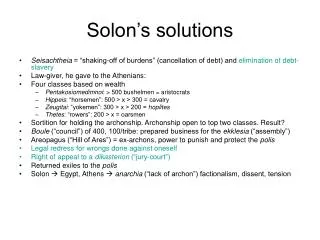
Solon’s solutions • Seisachtheia = “shaking-off of burdens” (cancellation of debt) and elimination of debt-slavery • Law-giver, he gave to the Athenians: • Four classes based on wealth • Pentakosiomedimnoi: > 500 bushelmen = aristocrats • Hippeis: “horsemen”: 500 > x > 300 = cavalry • Zeugitai: “yokemen”: 300 > x > 200 = hoplites • Thetes: “rowers”: 200 > x = oarsmen • Sortition for holding the archonship. Archonship open to top two classes. Result? • Boule (“council”) of 400, 100/tribe: prepared business for the ekklesia (“assembly”) • Areopagus (“Hill of Ares”) = ex-archons, power to punish and protect the polis • Legal redress for wrongs done against oneself • Right of appeal to a dikasterion (“jury-court”) • Returned exiles to the polis • Solon Egypt, Athens anarchia (“lack of archon”) factionalism, dissent, tension
Solonian political changes • Political power based on wealth not birth • Political decisions no longer in hands of Areopagus only: boule (“council”) of 400 (100/tribe) and hence the demos (“people”) • Post-Solonian Athens: discontent, civil war, the rise of a tyrannos
For Wednesday • Was the Peisistratid tyranny inevitable, or did the Athenians have any other choice? • When the tyranny came to an end, what choices did the Athenians have?
Athenian tyrannos: Rise of the Peisistratids: Land and Resources • topography of Attica (Landsat) • reconstruction of Athens (Sikyon.com) Archaic Athens images: • composite plan (Acropolis, Athens) • model (classical Athens)
Peisistratus’ rise to power • anarchia, 590/89 and 586/5 BCE • Damasias, 582/1-580/79 BCE • Sources for Peisistratus: • Herodotus, Thucydides, Atthidographers, Archon lists, Athenaion Politeia = "Constitution of the Athenians" • Map of Attica • Factions: • "men of the plain" = pediakoi including Philaidai and Lykourgos (conservative) • "men of the coast" = paraloi including Alkmaionidai and Megakles (moderate) • "men of the hills" = hyperakrioi or diakrioi including Peisistratus (appeal to the masses) • Peisistratos as demotikotakos = "friend to democracy" • Peisistratos: home at Brauron, owns land in Thrace at Strymon River
Peisistratus’ tyrannies • 561/0 BCE with the club-bearers • 556/5 BCE with Phye of Paiania • 546/5 BCE with Battle of Pallene - 528/7 BCE
Peisistratus’ patronage • City Dionysia - 534/3 BCE (Dionysos and Satyrs) • Greater/Lesser Panathenaia - 566BCE(?) (Panathenaic Amphora: one obverse; one reverse) • Codification of Iliad and Odyssey • Temple of Athena on Akropolis (ca. 529 BCE) • Reconstruction • Temple of Olympian Zeus • Fountainhouses (510 BCE Vase)
Tyranny: The Next Generation • Hippias, 528-510 BCE • Hipparchos, 528-514 BCE • Tyrannicides: Harmodius and Aristogeiton, 514 BCE • Overthrow of Hippias: 511/0 BCE
Assessment of Solon and Peisistratids • What did Solon do for Athens? • What did Peisistratus do for Athens? • What did his sons do for Athens? • On balance, how do you view the political system of Athens in the 6th century BCE?