The Rise of the Atlantic World: Early Exploration and Its Impact (1400-1625)
Chapter 2 delves into the rise of the Atlantic World from 1400 to 1625, highlighting early exploration led by Portugal and Spain. It examines their motivations, including the search for gold and the introduction of the slave trade. The chapter covers significant figures like Christopher Columbus and Amerigo Vespucci, as well as the establishment of Spanish dominance through conquistadores like Hernán Cortés and Francisco Pizarro. It explores the consequences of European colonization, including the Columbian Exchange and the development of colonial governance in England, and sets the stage for future global interactions.
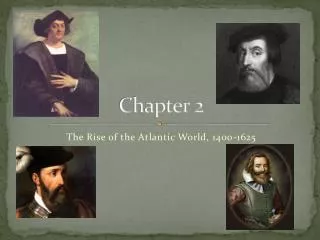

The Rise of the Atlantic World: Early Exploration and Its Impact (1400-1625)
E N D
Presentation Transcript
Chapter 2 The Rise of the Atlantic World, 1400-1625
Early Exploration • Portugal • Involvement in Africa • The search for gold • Introduction to the slave trade • New Slavery www.google.com/maps
Early Exploration • Christopher Columbus • Sailing West • Reasons? • A new world? • Other major explorers?
Reasons Simplified • God, Gold, and Glory!!!!! • Which one is the most important to the explorers?
Charting new territory • Amerigo Vespucci
Spanish Conquerors • Conquistadores • “Indian” slaves • Hernan Cortes and the Aztecs • Francisco Pizaaro and the Incas • Effects of the Spanish on the Natives
New Rules • Ruling the Aztecs • The EncomiendaSystem • Encomenderos
The Columbian Exchange • A Biological Encounter • Changes in the population • Peninsulares • Criollos • Mestizos • Mulattos
Spanish Territory • Florida • Texas • New Mexico • California • Mexico
The French get in the game • Late 1500s • St Lawrence Valley • South Carolina (Huguenots) • Florida • Quebec • Louisiana • Fur Traders The French were also influenced by God, Gold, and Glory…….fur became the french “gold”.
England • Late 1500s • Problems between Spain and England • Roanoke (1585)
England • Jamestown • The Virginia Company • Joint Stock Company • John Smith • The “Headright” System • Indentured Servants
England’s 3 types of colonies • Royal – A colony governed directly by a king through an appointed governor. • Proprietary – colonies granted to a group of private owners for development. • Charter Colonies – colonies to which the crown granted a charter for the purpose of establishing a government. Purpose is to make a profit.
England • The House of Burgesses (1619) • Representative Government • King James revoked the Charter • Jamestown becomes a royal colony (1624)
England • The Pilgrims (1620) • The Mayflower • Religious Reasons not freedom • New Jurisdiction • The Mayflower Compact
England • More Puritans • 1630s • Self governing farm community • “City on a hill” • Salem Witch Trials • Religious tolerance
Assignment • Workbook Chapter 2: • Multiple Choice 1-10 • Short Answer 3 and 5 • Essay number 2