Clinical Evaluation of HBF-500: Measurement Accuracy Compared to Tanita and SOEHNLE Products
The HBF-500 clinical evaluation test assesses the measurement accuracy of body fat percentage, skeletal muscle percentage, visceral fat levels, and resting metabolism. Conducted by the Christian-Albrechts-Universität zu Kiel, the study included 104 subjects (54 females and 52 males) for body fat and 100 subjects (51 females and 49 males) for skeletal muscle and resting metabolism. Results comparing HBF-500 to Tanita BC-532 and SOEHNLE Body Balance show that HBF-500 has a smaller measurement error, affirming its reliability for clinical applications.

Clinical Evaluation of HBF-500: Measurement Accuracy Compared to Tanita and SOEHNLE Products
E N D
Presentation Transcript
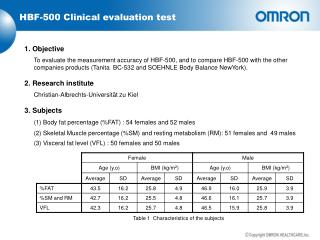
HBF-500 Clinical evaluation test 1. Objective To evaluate the measurement accuracy of HBF-500, and to compare HBF-500 with the other companies products (Tanita BC-532 and SOEHNLE Body Balance NewYork). 2. Research institute Christian-Albrechts-Universität zu Kiel 3. Subjects (1) Body fat percentage (%FAT) : 54 females and 52 males (2) Skeletal Muscle percentage (%SM) and resting metabolism (RM): 51 females and 49 males (3) Visceral fat level (VFL) : 50 females and 50 males Table 1 Characteristics of the subjects
HBF-500 Clinical evaluation test 4. Result of Body Fat percentage Figure 1 Correlation of measured value and DXA (Female) Figure 2 Correlation of measured value and DXA (Male)
HBF-500 Clinical evaluation test 5. Result of skeletal muscle percentage Figure 3 Correlation of measured value and MRI (Female and Male) 6. Result of visceral fat level Notes : MRI Visceral fat level =MRI Visceral fat area(cm2) / 10 Figure 4 Correlation of measured value and MRI (Female and Male)
HBF-500 Clinical evaluation test 7. Result of resting metabolism Figure 5 Correlation of measured value and Exhalation analysis (Female and Male)
Appendix 1 Tanita BC-532 Visceral fat level and Muscle mass A1-1. Result of Visceral fat level Comment : It is presumed that the error of TANITA is larger than that of HBF-500. Notes : MRI Visceral fat level =MRI Visceral fat area(cm2) / 10 “S.E.E” is not be described, because the calculation formula and the reference value of TANITA are uncertain, Figure A1-1 Correlation of measured value and MRI (Female and Male) A1-2. Result of Muscle mass Comment : The result of TANITA is different from the skeletal muscle mass, because TANITA uses DXA for the reference value. TANITA’s muscle mass = weight – fat mass – bone mass Notes : “S.E.E” is not be described, because the calculation formula and the reference value of TANITA are uncertain, Figure A1-2 Correlation of measured value and MRI (Female and Male)
Appendix 2 SOEHNLE Body Balance Muscle mass A2. Result of Muscle mass Comment : It is presumed that the error of SOEHNLE is larger than that of HBF-500. Notes : “S.E.E” is not be described, because the calculation formula and the reference value of SOEHNLE are uncertain, Figure A2 Correlation of measured value and MRI (Female and Male)
Appendix 3 HBF-400 Clinical evaluation test Result of Body Fat percentage Figure A3-1 Correlation of measured value and DXA (Female) Figure A3-2 Correlation of measured value and DXA (Male)