The U.S. Involvement in Vietnam: Origins, Escalation, and Consequences
This overview delves into the complex origins of U.S. involvement in Vietnam, beginning with President Truman's financial and military support for the French in 1950. It highlights key events and policies, such as Eisenhower's rejection of the Geneva Accords, Kennedy's introduction of Green Berets, and the Gulf of Tonkin Resolution that marked significant escalation. The narrative examines the Vietnam War's impact on soldiers, the anti-war movement, and pivotal moments like the Tet Offensive and My Lai Massacre, ultimately assessing the lasting consequences of America's decisions in Vietnam.
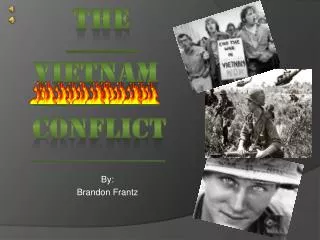

The U.S. Involvement in Vietnam: Origins, Escalation, and Consequences
E N D
Presentation Transcript
Vietnam __________________ By: Brandon Frantz Conflict ___________________ The__________
ORIGINS • In May 1950, President Truman allows financial and military support to the French who were fighting for control over their Indochina colony, which included Vietnam • The French suffer major losses, allow for the establishment of North and South Vietnam at the 17th parallel under the Geneva Accords • The U.S. government under Eisenhower rejects this arrangement and takes control from the French, works to unite Vietnam under democratic government • In 1961, Kennedy sends 400 Green Berets to assist the training of South Vietnamese • By the time of Kennedy’s assassination in 1963, there are over 16,000 military advisers in South Vietnam, over 100 Americans have been killed
Reasons for U.S. Involvement • President Truman’s policy of containment: prevention of the spread of communism • President Eisenhower’s Domino Theory: as one country falls to Communism, it will spread to neighboring nations
The Leaders • North Vietnam becomes Communist under Ho Chi Minh • Supported by China and Russia, other communist nations • U.S. places Ngo Dihn Diem into power in South Vietnam • Corrupt government and little public support
The Vietcong • Guerilla fighters against Diem in South Vietnam • Used hit and run tactics, set booby-traps, created complex tunnel systems • Supported by Ho Chi Minh • Lived within the farming villages of South Vietnam • Ho Chi Minh Trail • A network of paths used by North Vietnam to get supplies to the VC
Overthrow of Diem • Diem was very unpopular, mainly because of his intolerance of Buddhism • Buddhism was one of the nation’s leading religious practice • In 1963 a South Vietnamese military revolt supported by the U.S. led to Diem’s execution • America now played a major role in South Vietnamese politics Some Buddhist monks resorted to setting themselves on fire in protest of Diem’s policies
Gulf of Tonkin Resolution • August 2, 1964: President Johnson announces a North Vietnamese attack on U.S. battleships • Does not reveal that the U.S. ships were assisting the South Vietnamese in a raid against the North • Johnson immediately orders U.S. airstrikes • August 7, 1964: Congress passes the Gulf of Tonkin Resolution • Gives the president the power to “take all necessary measures to repel any armed attack against the forces of the United States and to prevent further aggression” • “Blank check” LBJ
Escalation • Operation Rolling Thunder: Johnson’s continuous bombing of North Vietnam • Johnson orders the first combat troops into Vietnam • More that 180,000 troops in Vietnam by the end of 1965 • Number doubles by 1966 • American confidence is high
The Battlefield • American soldiers had to adjust to the harsh jungles of Vietnam, areas well known by the VC • The Vietcong used ambushes and hid among the general population of farmers • American soldiers used Search and Destroy missions to seek out the enemies and their supplies • The war became measured by body count • Napalm, which causes widespread fires, and Agent Orange, a chemical that destroys vegetation, were used to clear the thick Vietnam jungles • Agent Orange led to many health hazards for both the Vietnamese and Americans, and also caused debilitating birth defects
The Soldiers • The average age of an American soldier was 19 • Most soldiers were drafted • Usually served a Tour of Duty, 1 year of combat • Many veterans return home with Post Traumatic Stress Disorder • Experienced prejudice after returning home • Many seen as “baby killers” following the civilian casualties in Vietnam
Anti-War Movement • Hawks (pro-war) vs. Doves (anti-war) • “Living Room War” – Americans were able to watch recent events in the war effort on TV, first time in history • Counterculture Revolution: rebelling against the “cookie-cutter” society • Anger over the draft • Kent State University – May 4, 1970 • National Guard troops open fire on college students protesting Vietnam • 4 students killed
My Lai • American platoon under command of Lieutenant William Calley massacred 200+ innocent villagers (old men, women, and children) in 1968 • Not revealed to public until a year later • Convinces many Americans of the futility of the war • “Hey, hey, LBJ! How many kids did you kill today?”
1968-1969 • Tet Offensive, North Vietnamese Army and VC attack major cities and air bases in the South • Surprises American public who believed the war would soon be over • Seen as the turning point of the war for the North • Johnson does not seek reelection, Nixon becomes president Vietcong soldier executed following the Tet Offensive
History Channel: Vietnam in HD Tet Offensive: January 31, 1968
Nixon’s Policy • Appoints Henry Kissinger, begins peace talks with the North’s Le DucTho, discuss cease-fire and return of POWS • Continue for 4 more years • Nixon begins Vietnamization: gradual withdrawal of troops as South Vietnam took on more of the fighting • Nixon invades Cambodia in 1970, wants to destroy VC supplies • Public outrage, seen as widening the war • Kent State massacre follows Kissinger and Le DucTho
The Beginning of the End • Polls in 1971 show that 2/3 of Americans wanted an end to the Vietnam conflict • South Vietnam’s current President, Nguyen Van Thieu, refused to allow a settlement leaving North Vietnamese troops in the South • In an effort to speed up peace negotiations, Nixon ordered the heaviest bombings of the North in the war’s history during December 1972 • Called the “Christmas Bombings” Nguyen Van Thieu
“Peace” • On January 27, 1973, North and South Vietnam signed and agreement “ending the war and restoring the peace to Vietnam” • North Vietnamese troops were allowed to stay in the south • America had promised to withdraw its troops and exchange POWs • After 8 years, the former longest wartime in its history, America had ended its direct involvement in the Vietnam Conflict
Fall of South Vietnam • In March 1975 North Vietnam launched a full-scale invasion of South Vietnam • Nguyen Van Thieu expected the U.S. to respond with force, as assured in the peace negotiations • By this time Nixon had resigned following the Watergate scandal, replaced by President Ford • Ford asked Congress for funds to aid South Vietnam but was denied • On April 30th North Vietnam captured Saigon, uniting Vietnam under Communism • Renamed the former South capital Ho Chi Minh City Evacuation of CIA personnel in Saigon
Aftermath • The war cost the U.S. $170 Billion directly • Indirect economic expenses also had a major effect • Approximately 58,000 American soldiers were killed in action • More than 300,000 injured • An estimated 1 million North and South Vietnamese were killed in the war • Countless civilian casualties
Sources • http://www.history.com/topics/vietnam-war • http://history1900s.about.com/od/vietnamwar/a/ vietnamwar.htm • http://www.pbs.org/battlefieldvietnam/timeline/index.html • http://www.english.illinois.edu/maps/vietnam/causes.htm • http://www.slideshare.net/jacobemiller/chap25-7391494