Download
1 / 16
160 likes | 177 Views
Explore Rome's origins, Republican conquests, Imperial rule, and legacy through notable figures like Caesar and Augustus. Discover how Rome's growth, civil wars, and military prowess shaped its history and downfall, leading to the Pax Romana and eventual decline.

E N D
Lecture On Rome Slides 1.1A-1.1E
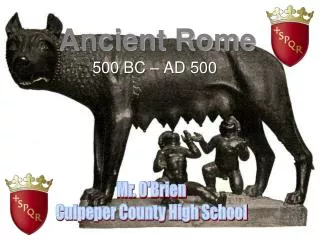
Slide 1.1A Rome’s Beginnings: Romulus and Remus • Mythical version: • Trojan prince Aeneas discovers Latin while looking for promised land. • Romulus and Remus, sons of Latin princess and god Mars, abandoned • Romulus and Remus cared for by she-wolf, discovered by shepherd and wife. • Romulus kills Remus; becomes first king of Rome.
Slide 1.1A continued • Historical version: • Latins settled on Palatine, a fertile area with pleasant climate, around 1200 B.C. • Etruscans (“people of the sea”) of Etruria ruled Rome (Latins) for 200 years. • Romans overthrew Etruscan leaders and set up a Republic in 509 B.C.
Slide 1.1 B The Expansion of the Roman Republic: The Battle of Zama • Romans conquered and controlled all of Italy by 275 B.C. • City-state Carthage ruled much of North Africa, Spain, and Sicily • Roman conflict with Carthage started the Punic Wars. • Romans fought Carthaginians for control of Mediterranean Sea.
Slide 1.1B continued • Hannibal defeated at Zama; Carthage lost all its territories to Rome • By 146 B.C. Rome was the leading power of the Mediterranean.
Slide 1.1C The final Years of the Roman Republic: Julius Caesar • Rome’s conquests caused changes in economy and government • Large estates replaced small farms; cities became crowded • Attempts were made to improve conditions in Rome • Gracchi brothers gave land and wheat to poor.
Slide 1.1C continued • General Mariusa gave power to the army • General Sulla gave more power to the Senate • Julius Caesar built up army and took power • Conquered Britain, Libya, Egypt, Cyrenaica, Numidia, Syria, Asia Minor • Caesar assassinated by those who opposed his dictatorship
Slide 1.1D The Roman Empire: Cleopatra’s Death • After Caesar’s death, power shared by Marc Antony, Lepidus, and Octavian • Civil war broke out between Antony and Cleopatra and Octavian • Octavian won naval victory at Actium in 31. B.C.
Slide 1.1D Continued • When Antony was defeated and Egypt was made a roman province, he and Cleopatra committed suicide to avoid being paraded through Rome as captives. • Octavian became absolute ruler of Rome; He was given the title “Augustus”(honored).
Slide 1.1D Continued • As Rome’s “first citizen” Augustus ended the expansion of the empire at its defensible boundaries: English channel; Rhine, Danube, and Euphrates rivers; And Sahara desert. • Augustus introduced the “Pax Romana” a time of peace and unity for the empire
Slide 1.1E The Roman Empire: Gladiatorial Games • Augustus’ successors accepted his defensive foreign policies • Trajan, Rome’s last great conqueror, established new provinces in Dacia, Armenia, Assyria, and Mesopotamia • Empire reached its greatest height under Trajan in A.D. 117
Slide 1.1 E Continued • Five Good Emperors ruled Rome between A.D. 96 and A.D. 186 • After A.D. 186 civil wars broke out in the Empire and emperors lost control • Rome’s size was difficult to manage; Dicoletian divided it in two
Slide 1.1 E Continued • Barbarians attacked the empire from many sides • Internally, gladiatorial games were one sign of Rome’s decline.