Religion Sparks Reform
150 likes | 525 Views
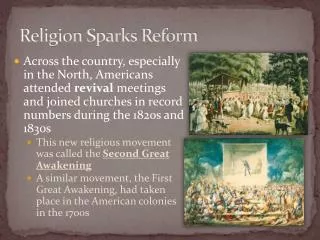
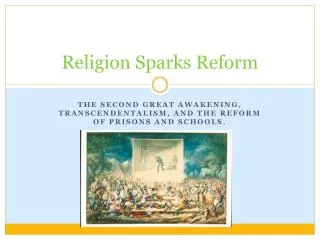
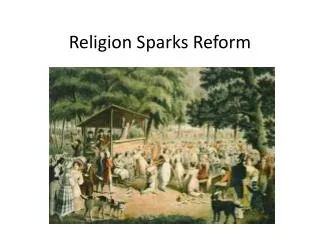
Religion Sparks Reform. Second Great Awakening. Post-1790, religious movement sweeps through the country Preachers focused on individualism and personal responsibility rather than predestination Mirrored the ideals of Jacksonian democracy which stressed the power of the common man.


Religion Sparks Reform
E N D
Presentation Transcript
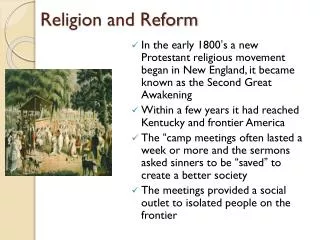
Second Great Awakening • Post-1790, religious movement sweeps through the country • Preachers focused on individualism and personal responsibility rather than predestination • Mirrored the ideals of Jacksonian democracy which stressed the power of the common man
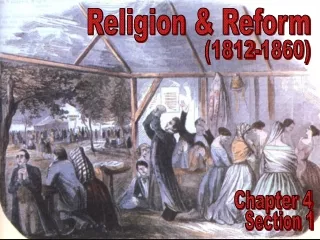
Revivals • Churches split and formed new denominations over these issues • Preachers traveled the country speaking at large gatherings called revivals (like a 19th century church retreat) • Charles Grandison Finney and others become well known speakers • 1800: 1 in 15 belonged to a church • 1850: 1 in 6 belonged to a church
African-American Church • Second Great Awakening brought the message that God was for all, black or white • Baptist and Methodist churches throughout the South welcomed slaves to their services • Slaves interpreted the message of Christianity as one of promised freedom for their people • Many free African Americans in the East worshipped in their own congregations
The Black Church Influences Politics • Membership in Richard Allen’s African Methodist Episcopal Church grew rapidly • Became a political, cultural, and social center • Provided education and health services • Through the church, African Americans began to develop a political voice • Black National Convention held in Philadelphia in 1830, became an annual event
Transcendentalism • Philosophical and literary movement • Stressed living a simple life • Celebrated truth in nature, personal emotion, and imagination • Authors like Ralph Waldo Emerson and Henry David Thoreau led the movement • Emphasized American ideals of optimism, freedom, and self reliance
“Go confidently in the direction of your dreams. Live the life you have imagined.” • Henry David Thoreau
“I went to the woods because I wished to live deliberately, to front only the essential facts of life, and see if I could not learn what it had to teach, and not, when I came to die, discover that I had not lived.” • Henry David Thoreau
“Do not go where the path may lead, go instead where there is no path and leave a trail.” • Ralph Waldo Emerson
“Peace cannot be achieved through violence, it can only be attained through understanding.” • Ralph Waldo Emerson
Unitarianism • Rather than looking to emotions, Unitarians stressed reason and conscience • Many wealthy, educated New Englanders subscribed to these belief systems • Believed that the purpose of Christianity was to perfect human nature and make men “nobler beings”
Utopian Communities • Utopia: a perfect place • Many communities emerged across the country, following different philosophies • Shaker Communities • Shared all of their goods • Men and women were equal • Pacifists • Could not marry or have children
Prison Reform • Dorothea Dix: led a movement that founded public hospitals for the mentally ill • Prison reformers emphasized rehabilitation rather than just punishment • Like revivalists, believed there was hope for everyone
Education Reform • No uniform educational policy existed • Only Vermont and Massachusetts had school attendance laws • Classrooms were not divided by grade • Few children stayed in school beyond age 10
Education Reform • 1830s: Americans begin to demand tax-supported public schools • Horace Mann: “If we do not prepare children to become good citizens, … if we do not enrich their minds with knowledge, then our republic must go down to destruction, as others have gone before it.” • By 1850s every state had publicly funded schools of some kind