Download
1 / 16
160 likes | 328 Views
This analysis explores the tragic failure of the Puritan community in early America, focusing on the inner tensions between the consciousness of sin and the aspiration toward grace. It examines key concepts such as the Halfway Covenant and Sumptuary Laws, illustrating how compromises with worldly values led to the community's decline. The work of figures like John Cotton and Roger Williams sheds light on the impossible ideal of a "City on a Hill," revealing the struggles against human imperfections and social divisions that ultimately undermined Puritan unity.

E N D
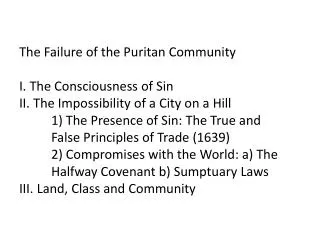
The Failure of the Puritan CommunityI. The Consciousness of SinII. The Impossibility of a City on a Hill 1) The Presence of Sin: The True and False Principles of Trade (1639) 2) Compromises with the World: a) The Halfway Covenant b) Sumptuary LawsIII. Land, Class and Community
Terms:Sumptuary Laws“Spiritual Milk for American Babes” (1646)True & False Principles of Trade (1639)Halfway Covenant (1662)
Themes:1) Puritans lived with tremendous inner tension. The consciousness of sin always battled with the aspiration toward grace.2) Their perfect community was doomed to failure. Human imperfections and growing social tensions made it impossible to sustain.
John Cotton, Spiritual Milk for American Babes (1646) reflects the inner anxieties of Puritanism
"forced worship stinks in God's nostrils“ – Roger Williams.Williams arrived in Massachusetts in 1631 and was in exile in Rhode Island by 1636
Solomon Stoddard’s House, NorthamptonStoddard was a major supporter of the Halfway Covenant
The Savage Family, a 1779 painting by the New England painter Edward Savage
Within a few generations competition for land undermined the early sense of community.