Viral Hemorrhagic Fevers: Agents, Transmission, and Control Measures
210 likes | 301 Views
Explore the diverse group of viral hemorrhagic fevers caused by RNA viruses, their clinical presentation, transmission, treatment, and infection control measures outlined by CDC and AFIP.


Viral Hemorrhagic Fevers: Agents, Transmission, and Control Measures
E N D
Presentation Transcript
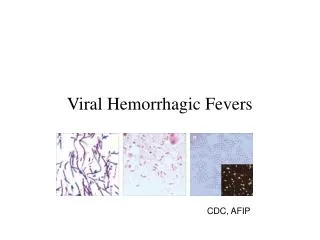
Viral Hemorrhagic Fevers CDC, AFIP
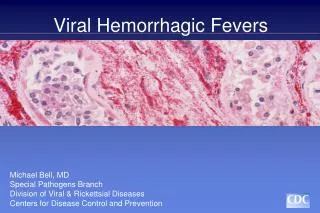
Viral Hemorrhagic Fevers • Diverse group of illnesses caused by RNA viruses from 4 families: • Arenaviridae, Bunyaviridae, Filoviridae, Flaviridae • Differ by geographic occurrence and vector/reservoir • Share certain clinical and pathogenic features • Potential for aerosol dissemination, with human infection via respiratory route (except dengue) • Target organ: vascular bed • Mortality 0.5 - 90%, depending on agent
Viral Hemorrhagic Fevers • Category A agents • Filoviruses • Arenaviruses • Category C agents • Hantaviruses • Tick-borne hemorrhagic fever viruses • Yellow fever
Viral Hemorrhagic Fevers Transmission • Zoonotic diseases • Rodents and arthropods main reservoir • Humans infected via bite of infected arthropod, inhalation of rodent excreta, or contact with infected animal carcasses • Person-to-person transmission possible with several agents • Primarily via blood or bodily fluid exposure • Rare instances of airborne transmission with arenaviruses and filoviruses • Rift Valley fever has potential to infect domestic animals following a biological attack
Viral Hemorrhagic FeversClinical Presentation • Clinical manifestations nonspecific, vary by agent • Incubation period 2-21 days, depending on agent • Onset typically abrupt with filoviruses, flaviviruses, and Rift Valley fever • Onset more insidious with arenaviruses
High fever Headache Malaise Weakness Exhaustion Dizziness Muscle aches Joint pain Nausea Non-bloody diarrhea Viral Hemorrhagic FeversInitialSymptoms Prodromal illness lasting < 1 week may include:
Flushing, conjunctival injection (“red eye”) Pharyngitis Rash Edema Hypotension Shock Mucous membrane bleeding Viral Hemorrhagic FeversClinical Signs
VHF Surveillance: Clinical Identification of Suspected Cases • Clinical criteria: • Temperature 101 F(38.3 C) for <3 weeks • Severe illness and no predisposing factors for hemorrhagic manifestations • 2 or more of the following: • Hemorrhagic or purple rash • Epistaxis • Hematemesis • Hemoptysis • Blood in stools • Other hemorrhagic symptoms • No established alternative diagnosis JAMA 2002;287 Adapted from WHO
Viral Hemorrhagic FeversTreatment • Supportive care • Correct coagulopathies as needed • No antiplatelet drugs or IM injections • Investigational treatments, available under protocol: • Ribavirin x 10 days for arenaviridae and bunyaviridae • Convalescent plasma w/in 8d of onset for AHF
Viral Hemorrhagic Fevers Management of Exposed Persons • Medical surveillance for all potentially exposed persons, close contacts, and high-risk contacts (i.e., mucous membrane or percutaneous exposure) x 21 days • Report hemorrhagic symptoms (slide 47) • Record fever 2x/day • Report temperatures 101F(38.3C) • Initiate presumptive ribavirin therapy • Percutaneous/mucocutaneous exposure to blood or body fluids of infected: • Wash thoroughly with soap and water, irrigate mucous membranes with water or saline
Viral Hemorrhagic FeversManagement of Exposed Persons • Patients convalescing should refrain from sexual activity for 3 months post-recovery (arenavirus or filovirus infection) • Only licensed vaccine: Yellow Fever • Investigational vaccines: AHF, RV, HV • Possible use of ribavirin to high-risk contacts of CCHF and LF patients
Viral Hemorrhagic FeversInfection Control • Airborne & contact precautions for health care, environmental, and laboratory workers • Negative pressure room, if available • 6-12 air changes/hour • Exhausted outdoors or through HEPA filter • Personal protective equipment • Double gloves • Impermeable gowns, leg and shoe coverings • Face shields and eye protection • N-95 mask or PAPR
Viral Hemorrhagic FeversInfection Control • Dedicated medical equipment for patients • If available, point-of-care analyzers for routine laboratory analyses • If unavailable, pretreat serum w/Triton X-100 • Lab samples double-bagged & hand-carried to lab • Prompt burial or cremation of deceased with minimal handling • Autopsies performed only by trained personnel with PPE
Viral Hemorrhagic FeversSummary of Key Points • A thorough travel and exposure history is key to distinguishing naturally occurring from intentional viral hemorrhagic fever cases. • Viral hemorrhagic fevers can be transmitted via exposure to blood and bodily fluids.
Viral Hemorrhagic FeversSummary of Key Points • Contact and airborne precautions are recommended for health care workers caring for infected patients. • Post-exposure management consists of surveillance for fever and hemorrhagic symptoms, and possibly ribavirin therapy for symptomatic individuals.
Case Reports • Tularemia • Viral Hemorrhagic Fevers MMWR Morb Mortal Wkly Rep 2001;50(33) MMWR Morb Mortal Wkly Rep 2001;50(5)
Resources • Centers for Disease Control & Prevention • Bioterrorism Web page: • CDC Office of Health and Safety Information System (personal protective equipment) • USAMRIID -- includes link to on-line version of Medical Management of Biological Casualties Handbook http://www.bt.cdc.gov/ http://www.cdc.gov/od/ohs/ http://www.usamriid.army.mil/
Resources • Office of the Surgeon General: Medical Nuclear, Biological and Chemical Information • St. Louis University Center for the Study of Bioterrorism and Emerging Infections http://www.nbc-med.org http://bioterrorism.slu.edu