Download
1 / 5
60 likes | 206 Views
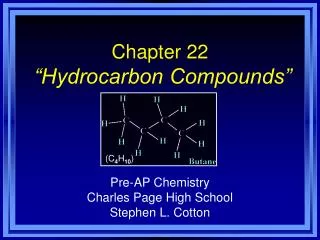
This overview explores the three primary sources of hydrocarbons: natural gas, petroleum, and coal. Natural gas, primarily composed of methane, is favored for combustion due to its clean-burning characteristics. It undergoes separation and liquefaction to yield liquid petroleum gas (LPG). Petroleum, known as crude oil, comprises alkanes that are refined through distillation. The cracking process creates more useful molecules for fuel and plastics. Lastly, coal forms from decomposed vegetation, progressing from peat to lignite and hard coal, which have varying carbon content.

E N D
Chemistry 121/122 Hydrocarbons from the Earth’s crust
Natural Gas • Made up of hydrocarbons with low molar masses (mostly methane) • Good for combustion because it burns with a hot, clean flame • Natural gas is separated into its hydrocarbon components through liquefaction • They are sold as liquid petroleum gas (LPG)
Petroleum • Otherwise known as crude oil • Most are straight chain and branched chain alkanes • Amount of carbon can vary from 1 – 40 • The mixture has to be separated, or refined, in order to be useful • This begins with distillation into fractions according to boiling points
Cracking • Due to the demand of gasoline, chains of carbon that do not fall under its criteria need to be broken, or cracked, into more useful molecules • Cracking can occur with catalysts and heat • Some of these molecules are also used to manufacture plastics and paints
Coal • Vegetation died and became peat • Peat can be used an an inexpensive fuel • If left in the ground, it can eventually turn into lignite, or brown coal, then bituminous coal, and ultimately, hard coal • All have increasing amounts of carbon and lesser amount of water • Obtained by mining • Mostly composed of aromatic compounds of high molar mass