The passive Summary
130 likes | 147 Views
This text explores the meaning, syntax, and criticism of the passive voice in German. It also analyzes the aspectual form and arguments supporting the aspect analysis.


The passive Summary
E N D
Presentation Transcript
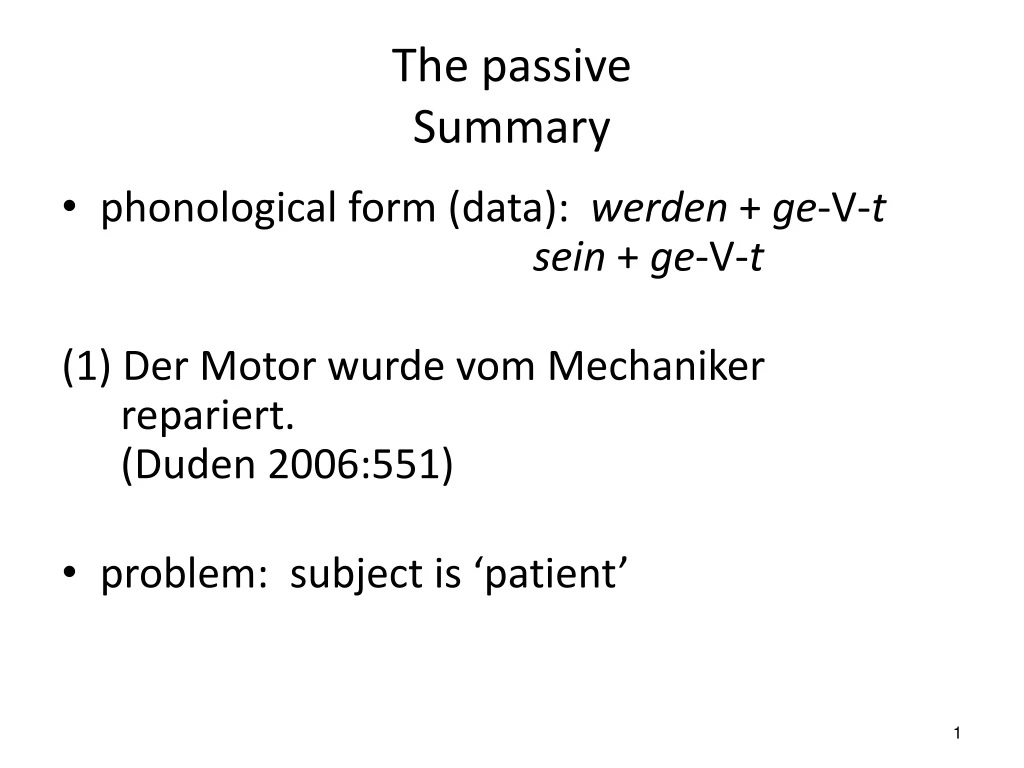
The passiveSummary • phonological form (data): werden + ge-V-tsein + ge-V-t (1) Der Motor wurde vom Mechaniker repariert. (Duden 2006:551) • problem: subject is ‘patient’
Aims of analysis • meaning of werden + ge-V-t? • syntax: combinable with which verbs and sentences? • (grammatical) form: what grammatical construction does it represent? (How is it to be parsed?)
Voice analysis (Genus verbi) • (Grammatical) Form: • passive derived from active • active and passive are ‘voices’ of the verb • Der Mechaniker reparierte den Motor→Der Motor wurde vom Mechaniker repariert • explains why subject is patient – because it started out as an object
Meaning: • passive synonymous with active • except for theme-rheme organisation • motivation for passive: to make the patient theme
Syntax: • all and only transitive verbs (i.e. followed by object, especially in Acc.) are passivizable • exceptions are listed individually • e.g. besitzen, mögen, kosten
Criticism of voice analysis:contradictions, anomalies, flaws • meaning of werden + ge-V-t? • five formal differences – synonymous?!? • agentive von-phrase • statal passive
adjectival properties • impersonal passive from intrans. verbs: Es wurde getanzt • transitive verbs which do not form a passive, e.g. besitzen, mögen, kosten
Aspect analysis • phonological form (data): werden/sein + ge-V-t • (Grammatical) Form: aspect of type Auxiliary + Participle, like the perfect • Meaning: new state as result of preceding action (change of state) (hence subject is patient) • Syntax: determined by lexical aspect of verb and compositional aspect of sentence (as with perfect): telic
Der Schülerwurde (von dem Lehrer) gelobt(Helbig & Buscha 161-188) analysed as an aspect • der Schüler: subject taken from the lexicon, as with the perfect • wurde: aspectual auxiliary, like haben and sein • von dem Lehrer: a normal prepositional phrase (PP); von means ‘agent’; like many PPs optional, as in Er war böse (auf ihn) • gelobt: aspectual participle, like the homonymous perfect participle • wurdegelobt means ‘action + state’ (hence subject is patient)
trans. non-passivizable verbs explained: lexical and compositional aspect, as always with Auxiliary + Participle aspects • for a verb/sentence to be passivizable there must be an end-point potentially present, which becomes the end-state of the passive meaning ‘action + state’ • i.e. a verb/sentence must be telic to form a passive • proof? Yes, formal-syntactic proof: • recall: we said under Aspect that to form a resultative perfect a verb must be telic • it follows that non-passivizable transitive verbs should also not form a resultative perfect
This does indeed turn out to be the case for 2/3 of non-passivizable transitive verbs: • (2) a. Hans mochte den Roman. • b. *Der Roman wurde von Hans gemocht. • c. *Jetzt hat Hans den Roman gemocht. • (3) a. Er besitzt ein großes Haus. • b. *Ein großes Haus wird von ihm besessen. • c. *Jetzt hat er ein großes Haus besessen. • (4) a. Er bekam den Brief. • b. *Der Brief wurde von ihm bekommen. • c. Jetzt hat er den Brief bekommen. • (see Beedham 1982:59-82, 2005:52-56)