Understanding Progeria and its Impact on Genetics
Progeria, known as Hutchinson-Gilford Progeria Syndrome, is a rare genetic condition that significantly accelerates aging in children, with symptoms appearing as early as 18 months. Those affected experience hair loss, a small face, thin skin, and a short stature; they typically live into their early teens due to complications like heart disease. This condition is not only tragic but also highlights genetic principles such as incomplete dominance and polygenic traits. Learning about progeria enhances our understanding of inheritance patterns and genetic diseases, informing research and potential treatments.

Understanding Progeria and its Impact on Genetics
E N D
Presentation Transcript
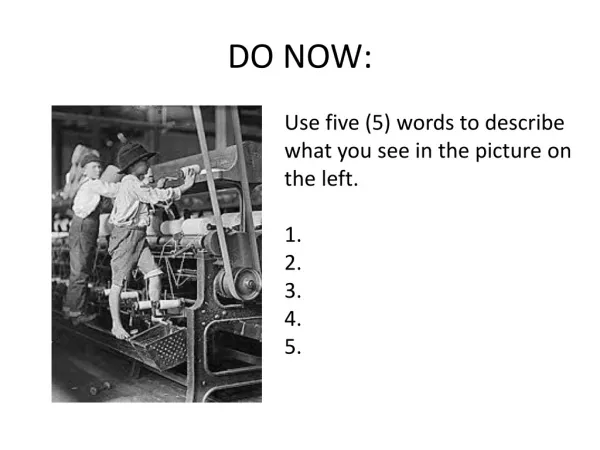
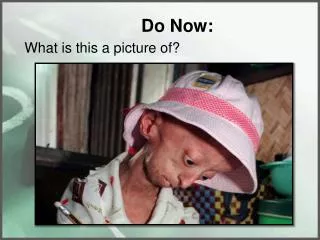
Do Now: What is this a picture of?
Do Now: • Brad Pitt's role in "The Curious Case of Benjamin Button" was based on a real life medical condition. Progeria, also known as Hutchinson-Gilford Progeria syndrome, it is a disease that accelerates the aging process when a child is 18 to 24 months old. • As the child grows, some symptoms include hair loss, a small face, thin skin, loss of body fat, and a short stature. • Children with progeria age six to eight times faster than the average person, and rarely live past the age of 13, due to heart disease. • Only about 100 cases of progeria have ever been formally diagnosed in medical history. The odds of being diagnosed are roughly one in 8 million.
Homework • Read pages 319 - 321 • Make sure you know these terms • Incomplete Dominance • Co-dominance • Multiple Alleles • Polygenic traits
Review /New Material • Inbreeding: • The continuous breeding of an individual with similar characteristics. • What is the danger? • Too close to one another genetically so both the good genes and the bad can remain, and be expressed. Much like the Amish where after a few generations there is very little variation.
Review /New Material • Much like the Amish where after a few generations there is very little variation. • Genetic drift
Review • Genotype – the genetic makeup of a gene (TT, Tt, tt) • Homozygous –Same type of alleles (Tall – Tall= TT) or (short- short=tt) • Heterozygous – both different (Tall-short = Tt).
New material • Mendel Realized that he predicted how plants would turn out through the use of “Probability.” Not always 100% certain, it was fairly accurate for guessing the outcomes (not taking into account mutations (Progeria for example) or outside forces (rain, fire,….)
New material • Monohybrid vs. Dihybrid • Below is monohybrid – why? • Only one trait - Tall
New material • Only one trait – Height (Tt X Tt (or tt X Tt)) • Work it out
Review • Mendel used the Law of Segregation to predict outcomes. • For example parents with the traits of T= Tall, t= Short, so if two parents had kids we would expect that of there is a 25% chance of having a short child. Often predicted that 1 and 4 chance of having a short child, but is that true? Explain
Phenotype vs. Genotype • Phenotype – Physical Trait (Tall) • Genotype – genetic make up (TT or Tt) • Punnet Squares – mathematical formula to determine outcomes. 4 Box vs. 16 Boxes
Dihybrid Di-hybrid – deals with two traits. (p. 316) – each box will have 4 alleles = BbTt X BbTt. B- Brown Hair, b – Red Hair, T – Tall, t – Short
Dihybrid Do the following - BbTt X BbTt. B- Brown Hair, b – Red Hair, T – Tall, t – Short • BT bTBtbt • BT • bT • Bt • bt
Ratios • How many Brown Hair and Tall will you have? • How many Brown Hair & short • How many Red Hair & Tall • How many Red Hair & short
Do the following Create the genotype formula for Hitler’s Master Race How did he get to this?
Do the following Do the following - BbGgX BbGg. B- Brown Hair, b – blonde hair, G – green eyes, g – blue eyes
Do the following Do the following - BbGgX BbGg. B- Brown Hair, b – blonde hair, G – green eyes, g – blue eyes BG bGBgbg BG bG Bb Bg bg BBGG BbGGBBGgBbGg
Do the following Do the following - BbGgX BbGg. B- Brown Hair, b – blonde hair, G – green eyes, g – blue eyes BG bGBgbg BG bG Bb Bg bg
Review From the previous is how you would get to the traits necessary to develop the “Master Race” – bbgg (blonde hair & blue eyes.
Review To do a Punnett Square – Mom’s traits (Tt) & dad’s traits (tt). Can only do one trait at a time. In this case mom is tall and dad is short.