Download
1 / 29
290 likes | 403 Views
Welcome to Northwest! Your State Arboretum. Missouri Comprehensive State Energy Plan, Public Meeting #5 Student Union Ballroom October 23, 2014. Northwest, Big Picture. Performance Key metrics/comparatives Progress Deep and significant partnerships Overall improvements Plans

E N D
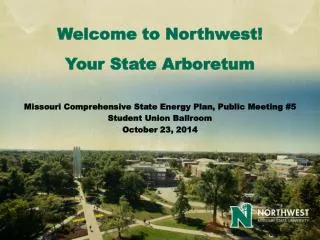
Welcome to Northwest! • Your State Arboretum • Missouri Comprehensive State Energy Plan, Public Meeting #5 • Student Union Ballroom • October 23, 2014
Northwest, Big Picture • Performance • Key metrics/comparatives • Progress • Deep and significant partnerships • Overall improvements • Plans • Strategic Plan implementation • Comprehensive Campaign
Northwest Missouri State University’s Approach to Energy and Sustainability
Overview • Missouri’s unique position • Demand side management opportunities • Utilizing alternative energy at Northwest • Energy conservation at Northwest
NationalEnergy Trend • Year Energy Intensity • 1980 13,381 Btu/$ • 2011 7,328 Btu/$ • Energy prices • Technology • Generation • Distribution • End Use
Missouri’s Energy Profile 1,064,503 879,377 USA coal consumption has decreased 17.4% vs. 1.5% increase for Missouri (2008-2013) Missouri electricity rates have increased 31% vs. 3.5% for USA (2008-2013) Missouri electricity expense has increased $1.5B or 28% vs. 2.5% for USA (2008-2013)
Costs: New Capacity vs. Conservation • If our current level of DSM is less than ideal, what are the obstacles to optimization? • Lack of incentives for operational changes • Temperature and pressure resets. Reviewing sequences, schedules, economizer operation, sensor calibration. • Cost-effective measures with low capital costs and fast ROIs overlooked. • Products • Magic power factor correctors, “efficient” resistant heaters / extraordinary claims muddy the waters for facility operators. • What are the new products? Cutting edge? Tried and true? • Incentives • MEEIA (Missouri Energy Efficiency Investment Act) provides the mechanism for recovery but fails to ensure the most cost-effective level of investment. • Align programs to utilities’ and users’ interests. • Expanded incentives for custom and prescriptive measures but sparse for energy management / energy audits. • Project financing • Cost of capital difference • Lease arrangements • Building turnover
DSM Program Spending Per capita spending on energy efficiency programs by state
Northwest Fast Facts • Student population: ~ 6,800 • Gross square feet: ~ 2.2 million • Total utility spend: ~ $3.5 million • EUI (kBTU/ft2) ~ 132 • Campus electricity: ~ 7 MW peak • ~28,000 MWh/year • Distribution: Most buildings on central chilled water/steam plant
Northwest’s Alt Energy History • Wood Chips Brought Online 1981
Northwest’s Alt Energy History • Wood Boiler
Northwest’s Alt Energy History • Paper Pellets Brought Online 1992
Northwest’s Alt Energy History • Paper Pellets Brought Online 1992
Northwest’s Alt Energy History • Waste to Energy, 1998 and Process Patent, 2000
Northwest’s Alt Energy History • Pyrolysis Oil, 2010 and High Efficiency Burner, 2014
Northwest’s Alternative Energy Savings PREVENTED COSTS FROM USE OF ALTERNATIVE FUEL
Northwest’s Alt Energy Program • 100 year-old building • 50 year-old boiler(s) • Power Plant = same location as 1905 • Campus expansion • Campus changes • Location, location, location • Significant need for re-investment
Overview of Northwest’s • Energy Management Program Energy management program began in July 2011. The program focuses more on low cost operational changes rather than traditional high cap-ex performance contracts. Conservationmeasures • Operational • Schedules • Sequences of operation • New construction and renovation reviews • Curtailments • Absorber vs. centrifugal chillers • Rate savings on wood fuel contracts • Projects • Lighting • 4,835 T12 to T8 retrofits • 71HID to T5 upgrades • 245 LED and CFL replacements • 90 Occupancy sensors • Outdoor lighting times (astronomical) • Kitchen • 10 Energy star equipment • 4Demand controlled ventilation hoods • Variable Frequency drives • 31 Pumps and Fans; BAS and stand-alone • Controls • 1 Library air handlers, chiller, HW system • 24 Terminal devices at academic building • 15 Internet thermostats • Sub-metering • 6 Building Electrical • Updates to automation systems • Incentives • $211,804 in KCPL rebates • ~230 kW ~1,000,000 kWh/year • ~$920 / kW ~$0.225/kWh
Takeaways • Northwest: • High-performing • Significant progress • Executing plans • Longhistory and savings from alternative energy approach • Significantperformance in energy conservation • Northwest is and can serve as a role model across the state
Thank You! • James Teaney • Power Plant & Transportation Manager • jteaney@nwmissouri.edu • 660-562-1186 • Dan Boyt • Energy Manager • energy@nwmissouri.edu • 660-562-1182 • Dr. John Jasinski • President • johnj@nwmissouri.edu • 660-562-1110