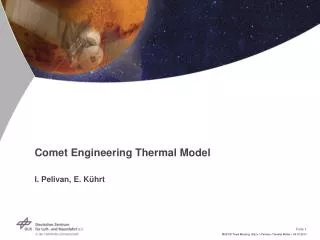
Comet Engineering Thermal Model I. Pelivan, E. Kührt
180 likes | 302 Views
This document outlines the development and implementation of an advanced thermal mathematical model (TMM) for the Rosetta lander, focusing on accurate predictions of comet surface temperatures influenced by ambient temperatures. The outdated comet surface temperature model (CSTM) is to be replaced with a new model that accounts for time-dependent solar insolation and thermal conditions, particularly for high latitudes. Intended for operational use with the Philae TMM, the model will aid in planning sequences for ground-testing, excluding landing site selection.


Comet Engineering Thermal Model I. Pelivan, E. Kührt
E N D
Presentation Transcript
Comet Engineering Thermal ModelI. Pelivan, E. Kührt MUPUS Team Meeting, Graz> I. Pelivan> Thermal Model > 24.10.2013
Reference: CSTM • Rosetta landersurfacetemperaturessignificantlydepend on ambienttemperatures -> cometsurfacetemperaturesneededasinputtolander thermal mathematicalmodel (TMM) • Outdated CSTM restrictedtoequatorshallbereplacedbymoresuitablemodelpredictingthesurface temperature depending on time and location • Intended for operational use with the Philae TMM (planning and ground-testing operational sequences, NOT landing site selection) MUPUS Team Meeting, Graz> I. Pelivan> Thermal Model > 24.10.2013
CSTM overview • Solve the 1D heat transport problem (ignore the lateral heat transfer) for a sphere • Include the time dependent (diurnal and seasonal) solar insolation at the surface boundary. • Assumes a no-heat transfer at the bottom boundary (adiabatic condition). • Set the simulation domain depth to 8 times the seasonal thermal penetration (necessary for high latitudes to achieve the required accuracy of the surface temperature) • One material component (no layering) was defined according to the parameters given in CSTM document • Energy consumption due to sublimation of water ice can be switched on and off • Sublimation is allowed only at surface. • The model was run for 3 orbital periods to ensure the convergence of the surface temperature (independent on initial conditions) • Approximations: • Heliocentric distance remains constant during one rotational period MUPUS Team Meeting, Graz> I. Pelivan> Thermal Model > 24.10.2013
Model input parameters MUPUS Team Meeting, Graz> I. Pelivan> Thermal Model > 24.10.2013
Model equations • Heatconduction: • Upperboundarycondition (conservationofenergy): • Lowerboundarycondition: • Initial condition: MUPUS Team Meeting, Graz> I. Pelivan> Thermal Model > 24.10.2013
Case study For 15 latitudes (89N, 85N, 75N, 60N, 45 N, 30N, 15N, 0, 15S, 30S, 45S, 60S, 75S, 85S, 89S) • Surface temperature from 3.25AU to 1.25 AU heliocentric distance in (inbound orbit) in steps of 0.25 AU • Outputs were generated for each of 6 cases in steps of 5 deg in hour angle US Rosetta Co-I Workshop> I. Pelivan> Thermal Model > 07.02.2013
Case study For 15 latitudes (89N, 85N, 75N, 60N, 45 N, 30N, 15N, 0, 15S, 30S, 45S, 60S, 75S, 85S, 89S) • Surface temperature from 3.25AU to 1.25 AU heliocentric distance in (inbound orbit) in steps of 0.25 AU • Outputs were generated for each of 6 cases in steps of 5 deg in hour angle US Rosetta Co-I Workshop> I. Pelivan> Thermal Model > 07.02.2013
Model output parameters For 15 latitudes (89N, 85N, 75N, 60N, 45 N, 30N, 15N, 0, 15S, 30S, 45S, 60S, 75S, 85S, 89S) • Surface temperature from 3.25AU to 1.25 AU heliocentric distance in (inbound orbit) in steps of 0.25 AU • Outputs were generated for each of 6 cases in steps of 5 deg in hour angle US Rosetta Co-I Workshop> I. Pelivan> Thermal Model > 07.02.2013
Someresults: active vs. inactivecomet • Sphere • Parameters used: recommended, with k = 0.1, 0.01, 0.001 W/m/K US Rosetta Co-I Workshop> I. Pelivan> Thermal Model > 07.02.2013
Someresults: active vs. inactivecomet, k = 0.001 W/m/K active inactive US Rosetta Co-I Workshop> I. Pelivan> Thermal Model > 07.02.2013
Someresults: comparisonwithdatafrom MIRO team ourmodel: red Miro: blue .. k1 - k01 -. k001 • min(ourmodel) = 28.0121 • max(ourmodel)= 359.0622 • min(MIRO) = 27.2600 • max(MIRO) = 360.6200 => 5 degshiftdetectedandcorrected in MIRO model US Rosetta Co-I Workshop> I. Pelivan> Thermal Model > 07.02.2013
Sphereresultssummary • Changing the dust thermal conductivity from 0.1 to 0.001 can change the surface temperature by as much as 35K. • Sublimation has a max. 35K effect on the surface temperature at 3AU but can differ by more than 150K at 1.25 AU. • The sublimation effect is stronger for a smaller thermal conductivity. US Rosetta Co-I Workshop> I. Pelivan> Thermal Model > 07.02.2013
Case study For 15 latitudes (89N, 85N, 75N, 60N, 45 N, 30N, 15N, 0, 15S, 30S, 45S, 60S, 75S, 85S, 89S) • Surface temperature from 3.25AU to 1.25 AU heliocentric distance in (inbound orbit) in steps of 0.25 AU • Outputs were generated for each of 6 cases in steps of 5 deg in hour angle US Rosetta Co-I Workshop> I. Pelivan> Thermal Model > 07.02.2013
Shape model(s) • Inclusionofanyshapemodelwithtriangular (orquadrilateralelements) • Shape modelpreprocessingfinished (check of normal vectororientation, processingofelementdata) • Validation ofrevisedsourcecodeforshapemodelinclusionandotherapectswithdataforsphere Wrong normal vectororientation vs. corrected, validation example US Rosetta Co-I Workshop> I. Pelivan> Thermal Model > 07.02.2013
Shape model(s) – cont‘d + some open points • New subroutines • calculationof solar incidence angle forshapeelements (boundarycondition) • Determination of Sun vectorandelement normal vector • Frame for NAIF SPICE ephemeridesasoptiontokepler(actualimplementationpending, seenextslide) • Open: • Model-specifictransformationroutines • Forarbitrarylocation on cometsurface: implementpoint-in-triangleroutine • NAIF SPICE interfaceforotherproducts? • Test implementations! US Rosetta Co-I Workshop> I. Pelivan> Thermal Model > 07.02.2013
Some design decisions • C insteadofFortran: • Compiler difficulties (solved) btw. NAG FortranandFortran SPICE Toolkit, still existing: run time problems (segmentation fault @ inaccessible NAG routine (TO BE REPLACED?) • CSPICE vs. Fortran Toolkit: also implementedwith IDL andMatlab US Rosetta Co-I Workshop> I. Pelivan> Thermal Model > 07.02.2013
Profile analysis – moreto do • Profiles: ____ k = constant - - - - k=c_k*T^3 • Temperaturedependanceof k leadstooveralltemperatureincrease • Surfacetemperaturepractically not depend on k US Rosetta Co-I Workshop> I. Pelivan> Thermal Model > 07.02.2013
Thermal engineeringmodelsummaryandoutlook • Original Fortran code re-implemented in C – update for shape model to follow • Final ephemerides implementation (only tested with separate program so far) • Physics updates where required (TBD) • Test new implementations and changes US Rosetta Co-I Workshop> I. Pelivan> Thermal Model > 07.02.2013