The Relentless March of Time and Macbeth's Descent into Darkness
This analysis delves into the themes of time and ambition in Shakespeare's "Macbeth." The quote “Tomorrow and tomorrow and tomorrow.../To the last syllable of recorded time” (5.5.22-26) reflects the inexorable passage of time and the futility of Macbeth's actions. As he spirals deeper into tyranny and moral decay, his decisions to commit heinous acts, like betraying his friend Banquo, illustrate his loss of empathy. Ultimately, Macbeth's ambition leads not only to his demise but also to a tragic understanding of life’s transience.

The Relentless March of Time and Macbeth's Descent into Darkness
E N D
Presentation Transcript
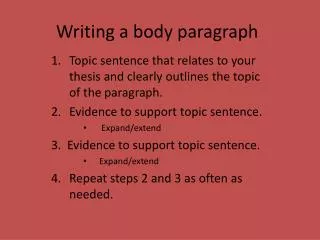
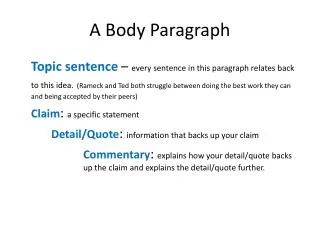
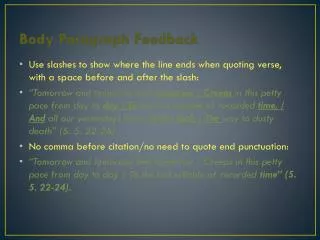
Body Paragraph Feedback • Use slashes to show where the line ends when quoting verse, with a space before and after the slash: • “Tomorrow and tomorrow and tomorrow / Creeps in this petty pace from day to day / To the last syllable of recorded time, / And all our yesterdays have lighted fools / The way to dusty death” (5. 5. 22-26). • No comma before citation/no need to quote end punctuation: • “Tomorrow and tomorrow and tomorrow / Creeps in this petty pace from day to day / To the last syllable of recorded time” (5. 5. 22-24).
Incorporating quotes: • If you set up a quote with a complete sentence, use a colon: Macbeth expresses his anticipation in an aside: “Glamis and thane of Cawdor! / The greatest is behind” (1. 3. 126-127). • Otherwise blend into your own sentence. However, you still want to maintain the grammatical integrity of your sentence: “The Captain states, speaking about Macbeth, “Till he unseamed him from the nave to th’ chops, / And fixed his head upon our battlements” (1. 2. 24-25). “The Captain states, speaking about Macbeth, that “he unseamed him from the nave to th’ chops, / And fixed his head upon our battlements” (1. 2. 24-25). It is not until later that Macbeth decides that he is “settled and bend up / Each corporal agent to this terrible feat” (1. 7. 92-93). It is not until later that Macbeth decides that he is “settled and bend[s] up / Each corporal agent to this terrible feat” (1. 7. 92-93).
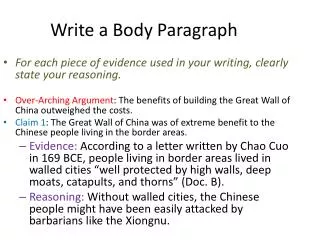
Give context before the quote, so that when you introduce the textual evidence, it is clear how the evidence will support the argument. • Macbeth does not inspire pity in the audience. He makes his own decision to commit atrocities, such as killing his loyal friend Banquo, and is hardly relatable to any audience or reader. This is shown when Macbeth says, “There’s comfort yet; they are assailable. / Then be thou jocund. Ere the bat hath flown / His cloistered flight, ere to black Hecate’s summons, / The shard-boned beetle with his drowsy hums / Hath rung night’s yawning peal, there shall be done / A deed of dreadful note” ( 3. 2. 41-46).
Macbeth does not inspire pity in the audience. He makes his own decisions to commit atrocities, and is hardly sympathetic to the audience. His penchant for merciless violence is demonstrated when he hints to his wife that he will have his loyal friend Banquo and Banquo's son Fleance killed: "There’s comfort yet; they are assailable. / Then be thou jocund. Ere the bat hath flown / His cloistered flight, ere to black Hecate’s summons, / The shard-boned beetle with his drowsy hums / Hath rung night’s yawning peal, there shall be done / A deed of dreadful note” ( 3. 2. 41-46).