Download
1 / 6
60 likes | 175 Views
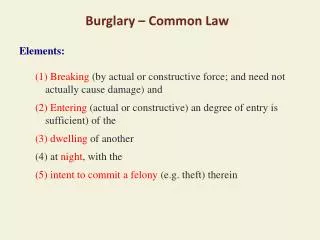
Burglary – Common Law. Elements: Breaking (by actual or constructive force; and need not actually cause damage) and Entering (actual or constructive) an degree of entry is sufficient) of the dwelling of another at night , with the intent to commit a felony (e.g. theft) therein.

E N D
Burglary – Common Law Elements: • Breaking(by actual or constructive force; and need not actually cause damage) and • Entering(actual or constructive) an degree of entry is sufficient) of the • dwellingof another • at night, with the • intent to commit a felony (e.g. theft) therein
Burglary – Modern Example - Illinois • Burglary: (class 2 felony) • Knowingly entering or remaining • In any building or vehicle that does not belong to the defendant • With the intent to commit a felony or theft therein • Class 1 felony if: The burglary is of a school OR of a residence • Criminal Trespass: • Knowingly entering or remaining on someone else’s property or vehicle (without an intent to commit a crime. (Misdemeanor) • Criminal Trespass of a dwelling that the defendant knew or should have known is inhabited by one or more people is a class 4 felony. Some jurisdictions also increase the grade of felony if the defendant is armed and/or injures the inhabitants etc.
Arson – Common Law Elements: • The malicious • burning(damage is required) • of the dwelling • of another • by fire(or explosion)
Arson – Modern Rules • Modern statutes have eliminated most of the elements • General intent (no malice required) • Water is also good enough • No requirement of dwelling, or even building • Can be one’s own house (e.g. for insurance collection purposes)
Arson – Modern Example – Rhode Island (minimum-maximum sentence in parentheses) • 7th degree: public unauthorized bonfire (fine of $100) • 6th degree: destruction of woodlands by fire (0-2 years) • 5th degree: destruction of property by fire or explosion (1-2 years) • 4th degree: destruction of property worth more than $100 by fire or explosion (1-3 years) • 3rd degree: destroying property by fire with intent to defraud an insurance company (2-20 years) • 2nd degree: destroying an unoccupied building or structure by fire or explosion (2-20 years) • 1st degree destroying an occupied building or residence (or one that was recently occupied) by fire or explosion (5 years - life) If someone dies in a fire set by a 3rd degree or higher arson, sentence must be at least 20 years.