Download
1 / 10
100 likes | 246 Views
This chapter delves into the fundamentals of sound waves, exploring how molecules obey simple harmonic motion (SHM) to create pressure and density variations in air. It discusses the relationships between pressure, displacement, and the characteristics of sound waves, including their speed in different media. The concepts of intensity level, loudness, and sound energy are examined, alongside practical problems in estimating sound range and absorption effects. Additionally, the chapter covers interference of sound waves, both constructive and destructive, highlighting the phenomena that shape musical sounds and pressure waves in pipes.

E N D
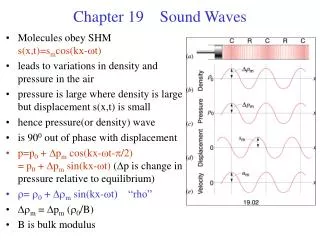
Chapter 19 Sound Waves • Molecules obey SHM s(x,t)=smcos(kx-t) • leads to variations in density and pressure in the air • pressure is large where density is large but displacement s(x,t) is small • hence pressure(or density) wave • is 900 out of phase with displacement • p=p0 + pm cos(kx-t-/2) = p0 + pm sin(kx-t) (p is change in pressure relative to equilibrium) • = 0 + m sin(kx-t) “rho” • m = pm (0/B) • B is bulk modulus
Speed of Sound • B=-p/(V/V) • Water: B~2.2x10⁹N/m2 Air: B~ 105 N/m2 • gases are more compressible (B is smaller) • speed of sound in a fluid depends on the density and the elasticity-> i.e. the medium • v = (B/0)1/2wave speed in a fluid • vair ~ 343 m/s at room temperature • vwater ~ 1482 m/s ( B is larger!) • vsteel ~ 5941 m/s
Intensity Level and Loudness • I=Pav/area • area of sphere = 4r2 => I 1/r2 • sensation of loudness is not directly proportional to intensity • varies as log(I) eg. log(100)=2log(10) • define sound levelSL=10 log(I/I0) in decibels (dB) • I0 = 10-12 W/m2 is the hearing threshold • hence for I=I0 , SL= 10 log(1) = 0 • pain threshold is I= 1 W/m2 or SL=10log(1012)=120 dB
Problem • When a pin of mass 0.1 g is dropped from a height of 1 m, 0.05% of its energy is converted into a sound pulse with a duration of 0.1 s. • (a) Estimate the range at which the dropped pin can be heard if the minimum audible intensity is 10 -11 W/m2 . • (b) Your result in (a) is much too large in practice because of background noise. If you assume that the intensity must be at least 10-8 W/m2 for the sound to be heard, estimate the range at which the dropped pin can be heard. (In both parts, assume that the intensity is P/4r2 .) • (a) Sound energy is 5 x 10⁻⁴(mgh) = 5 x 10⁻⁴ (1m)(10-4 kg)(9.8 m/s2 ) = 4.9 x 10⁻⁷ J • Pav = E/t = 4.9 x10⁻⁶ W = 4r2 x10-11 W => r ~ 200 m. • (b) r ~ 200/ (1000)1/2 = 6.24 m.
Problem • The equation I = Pav / 4r2 is predicated on the assumption that the transmitting medium does not absorb any energy. • It is known that absorption of sound by dry air results in a decrease of intensity of approximately 8 dB/km. • The intensity of sound at a distance of 120 m from a jet engine is 130 dB. • Find the intensity at 2.4 km from the jet engine (a) assuming no absorption of sound by air, and (b) assuming a diminution of 8 dB/km. (Assume that the sound radiates uniformly in all directions.) • (a) SL= 10 log(I1/I0)-10 log (I2/I0)= 10 log(I1/I2) = 10log(r22/r12)=20log(r2/r1) • 20 log (20) = 26; SL at 2.4 km = (130 - 26) dB = 104 dB • (b) Subtract 2.28 x8 dB from result of (a) • SL= (104 - 18.2) dB = 85.8 dB
Interference of Sound Waves ripple
Interference andPhase Difference • Consider shifting one of the waves by a distance relative to the other • they add up constructively • corresponds to a phase shift by = 2 • constructive interference for = m2 • or path differenceL= m • a shift by = corresponds to a shift of one of the waves by /2 • destructive interference for = (2m+1) • or path differenceL= (2m+1)/2
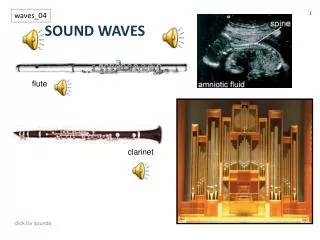
Musical Sounds • oscillating strings • membranes • air columns • standing wave patterns correspond to resonances • large amplitude oscillations push surrounding air and generate sound waves at the same frequency
Pressure waves in open pipe Pressure waves in pipe closed at one end