Understanding Sound Waves: Speed, Intensity, and Characteristics in Musical Instruments
240 likes | 375 Views
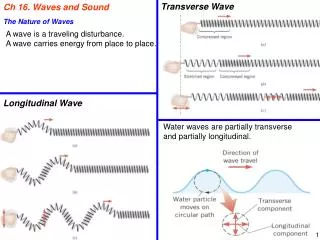
This chapter explores the fundamental aspects of sound waves, including speed variation with temperature, sound intensity, and the influence of different instruments like strings and pipes. It covers key concepts such as the Doppler Effect, interference patterns, and beats produced by sound waves. By examining examples like a piano wire and a Pepsi bottle, we delve into calculations involving frequency and resonance. The dynamics of sonic booms and shock waves are also discussed, providing a comprehensive overview of how sound interacts with various mediums.


Understanding Sound Waves: Speed, Intensity, and Characteristics in Musical Instruments
E N D
Presentation Transcript
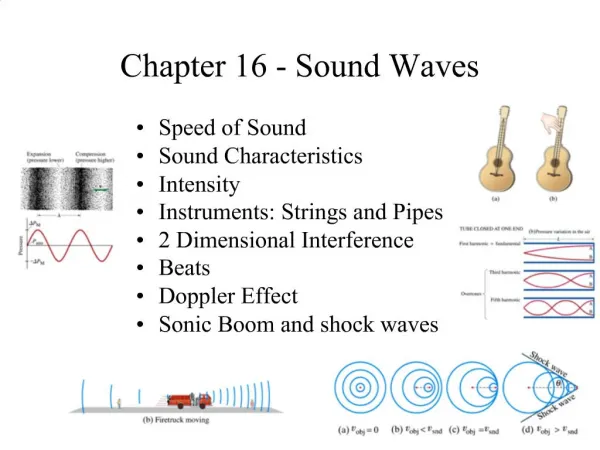
Speed of Sound Sound Characteristics Intensity Instruments: Strings and Pipes 2 Dimensional Interference Beats Doppler Effect Sonic Boom and shock waves Chapter 16 - Sound Waves
Sound Speed Variation with Temperature: Air Seawater
Pitch is frequency Middle C on the piano has a frequency of 262 Hz. What is the wavelength (in air)? 1.3 m
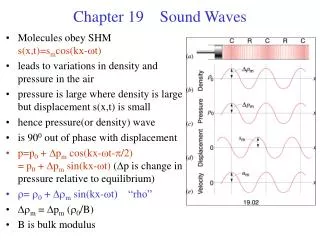
Intensity of sound • Loudness – intensity of the wave. Energy transported by a wave per unit time across a unit area perpendicular to the energy flow.
Question 1 • A steel wire in a piano has a length of 0.9 m and a mass of 5.4 g. To what tension must this wire be stretched so that its fundamental vibration corresponds to middle C: i.e., the vibration possess a frequency 261.6.
Wind instruments – Double open ended pipes Frequencies are identical to waves on a string
Wind instruments – Single open ended pipes Only odd harmonics are present
Question 2 – Pepsi Bottle • What is the fundamental frequency of a pepsi bottle 32 cm tall when you blow over it. Assume the speed of sound in air is 343 m/s. • 5 cm of water are added to the bottle. What is the new resonant frequency. 32 cm
Interference in Space When the path lengths from source to receiver differ by l/2 destructive interference results.
Interference in Time - Beats • Two sounds of different frequency: • Superposition:
Interference in Time - Beats • Trig identity again: Amplitude varies in time at a frequency equal to the difference in the two frequencies Beat Frequency
Doppler Effect – 4 cases • Source moving toward receiver • Source moving away from receiver • Receiver (observer) moving towards source • Receiver (observer) moving away from source.
Away: Source moving case Towards:
Receiver (observer) moving case Towards: Away:
Source and receiver moving • Numerator – Receiver (observer) • Toward + • Away – • Denominator – Source • Toward – • Away +
Doppler Example • Intelligence tells you that a particular piece of machinery in the engine room of a Soviet Victor III submarine emits a frequency of 320 Hz. Your sonar operator hears the machinery but reports the frequency is 325 Hz. Assume you have slowed to a negligible speed in order to better hear the Russian. • Is the VIII coming toward you or moving away from you? • Assuming the Victor is either moving directly toward or away from you, what is his speed in m/s?