Understanding the World Food Problem and Population Dynamics: Myths and Realities
This overview delves into the complex relationship between global food production and population growth, challenging long-standing myths about scarcity. It examines key theories from Malthus and Ehrlich, the demographic transition, and the impact of diseases like AIDS on population health and fertility. Furthermore, it highlights trends in food production per capita and emphasizes the importance of education and economic stability in addressing hunger. Despite challenges, recent evidence suggests that food production is increasingly meeting global needs.

Understanding the World Food Problem and Population Dynamics: Myths and Realities
E N D
Presentation Transcript
Population Sources: The World Food Problem Leathers and Foster, 2004 World Hunger 12 Myths Lappe Collins and Rossett, 1998 Hesketh et al., New England J. Med 353: 1171-1176 Wikipedia ttp://www.amazon.com/World-Food-Problem-Toward-Undernutrition/dp/1588266389
Thomas Malthus • 1798: Essay on the Principle of Population as it Affects the Future Improvement of Society • Population growth tends to outstrip the means of subsistence • Food increases arithmetically while population increases geometrically • The poor can be kept alive by charity, but since they would then propagate, this is cruelty in disguise. http://www.lakesideschool.org/studentweb/worldhistory/modernworld/images/malthus.jpg
Paul Ehrlich • 1968: The Population Bomb • “The battle to feed all of humanity is over. • In the 1970s the world will undergo famines— • Hundreds of millions of people are going to starve to death” http://bacs-s02.bacs.uq.edu.au/sib/sib-news/images/ehrlich1.jpg
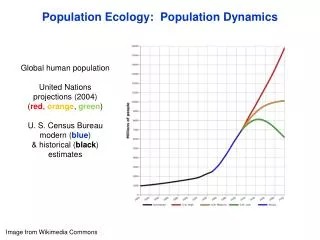
World Population through History http://newswhitehouse.com/worldpop.gif
Demographic Transition • First, high birth rates and high death rates • Then, improved living standards, health cause death rates to drop • Finally, low birth rates match low death rates
Global Death Rates • Demographic Transition: • First, death rates must drop • Then birth rates drop http://upload.wikimedia.org/wikipedia/commons/thumb/d/d7/Death_rate_world_map.PNG/800px-Death_rate_world_map.PNG
Demographic Transition • 1750-1950: Occurred in developed countries • 1950: Began to see death rates drop in developing countries • 2050: Projected completion of transition
Demographic Transition • Example: U.S. History • When agrarian society, people had many kids • Source of security, labor
Demographic Transition • Example: U.S. History • When became industrial, fewer kids/family • Lowered infant mortality • No need to rely on children’s labor • More opportunities for women • Happened without birth control Ford Motor assembly line http://websupport1.citytech.cuny.edu/Faculty/pcatapano/lectures_us2/Model_T_Assembly_Line.jpg
Global Fertility • 1950’s: 5 children/woman • 1970’s: 4 children/woman • 1990’s: 2.8 children/woman • Replacement: 2.1 children/woman
Global Population • Population growth rate is slowing down and will eventually stop • Dip in 1960 due to 30 million deaths in China • Great Leap Forward Famine http://www.census.gov/ipc/www/img/worldgr.gif
World Population Projection • Estimated to peak at 9 billion in 2070
Asia: 6.4 Billion China:: 1.3 Billion India: : 1.1 Billion Africa: 885 Million Americas: 875 Million Europe:: 727 Million Oceana: 32 Million World Population Demographics http://www.extension.umn.edu/distribution/livestocksystems/images/7220f03.gif
World Population http://www.theglobaleducationproject.org/earth/images/final-images/g-gpw-population-map.gif
AIDS • 40 million people infected with HIV • 2/3 in sub Sahara Africa • Many will die of AIDS • Will not greatly impact global population growth • Will Impact some countries • Losses by 2020: • Uganda 45% • Rwanda 35% • Malawi 30% Malawi AIDS orphans http://farm1.static.flickr.com/177/433616103_bd3f7cbef2.jpg?v=0
Global HIV 2006 http://upload.wikimedia.org/wikipedia/commons/thumb/6/68/People_living_with_HIV_AIDS_world_map.PNG/800px-People_living_with_HIV_AIDS_world_map.PNG
Food Production per Capita • Food Production per capita is rising worldwide • But falling in Africa • Food production is keeping up with population • Otherwise food prices would have risen • Food prices have dropped
Food Production in Sub-Saharan Africa • Food Production in Sub Saharan Africa not keeping up with population
Progressivist View • Things are good and getting better: • Worldwide standard of living • Education • Health • Trade • People are an asset. • Population causes shortages which raise prices, • stimulating entrepreneurs to satisfy the shortages. • We end up better off as a result. Julian Simon
Progressivist View • Two important indicators of progress and improvement in life are • Decreased Infant Mortality • Increased Life Expectancy
Progressivist View Elite Progress Elite Poor Population stimulates economy: progress. We are all better off Poor
Revisionist View • Adoption and spread of agriculture have trapped humanity in a spiral of • Population growth • Ecological destruction • Social tyranny. • The problem stems from the anti-ecological culture (religion) of agricultural societies • humans believe they are above and not part of nature (global ecosystem) • and therefore can destroy it at will. Civilization is based on Agriculture http://cache.virtualtourist.com/1928244-Skyline-New_York_City.jpg
Daniel Quinn • 1992: Ishmael • Although population is 5.5 billion, we produce enough food for 6.0 billion even though millions are starving • Because we produce enough food for 6 billion, in 3 or 4 years there will be 6 billion people. • Then, even though millions are starving, we will produce enough for 6.5 billion. • Thus in another 3-4 years there will be 6.5 billion • To halt this process, must face the fact that increasing food production doesn’t feed the hungry, it only fuels the population explosion.
Agricultural Revolution Hunters & Gatherers Agriculture Food production Expanding population & environmental destruction Conquest for land Population Growth Technology Culture
Revisionist View Elite Over-Population, Ecological Destruction Agriculture, Anti-Ecological Religion Wealth Resources Poor Root Causes Social Tyranny
Social Equity View • Problems of • poverty • overpopulation • ecological destruction • Are due to • inequity of wealth • unfairness of economic and social systems Frances Moore Lappe, Food First http://www.mediathatmattersfest.org/mtm05/img/frances_moore_lappe.jpg
Social Equity View • Inequity causes overpopulation • Poor have no other source of wealth • Overpopulation causes ecological destruction • Must make economic and social systems fairer • Share control of global resources more fairly • Economic democracy http://bks4.books.google.com/books?id=AoMrJnk-qhgC&printsec=frontcover&img=1&zoom=1&sig=ACfU3U3gtcaFOie7F_YcDq-G10QXTEZAQg
Social Equity View Elite Wealth Over-Population Ecological Destruction Poor Inequity = Root Cause
If the world were 100 people http://shoesforhumanity.org/images/graph.gif
If the world were 100 people (2008) • 50 male • 50 female • 61 Asians • 13 Africans • 12 Europeans • 9 Latin Americans • 5 USA and Canada • 1 South Pacific • 75 nonwhite • 25 white • 67 non-Christian • 33 Christian • 60 mistrust their own governments (Source: Family Care Foundation; 100 people.org)
If the world were 100 people(2008) • 47 are urban dwellers • 15 live in urban slums • 33 attempt to live on 3% of global income • 6 control 50% of the entire world’s wealth • Most are U.S. citizens • 1 has a college education • 1 owns a computer • 1 near birth • 1 near death
Both hunger and high fertility occur when: • Poverty is extreme and widespread • Society denies security and opportunity to people • Infant mortality is high • Most people can’t get land, jobs, education, health care, old age security • Few opportunities for women outside of home Bangladesh mother http://www.refugeesinternational.org/files/4738_image1_BA_1104_bihari_mother_and_child.jpg
Children • Labor force • Chance for a job in city • Security • major investment • rational choice 218 million children work http://mancelovici.files.wordpress.com/2007/07/nike_child_labor.jpg
Women’s Education • Powerful predictor of lower fertility • Reflects opportunity in society Girls in school, India http://upload.wikimedia.org/wikipedia/commons/thumb/b/b8/Girls_in_school_Gujarat.jpg/800px-Girls_in_school_Gujarat.jpg
Male Poverty • Low self-esteem • Dominate women and children • Thus more children
Examples • Sri Lanka: • lower price rice • led to population decline • Cuba: • low prices for food and health care • reduced population rate from 4.7 to 1.6 • Kerala, India: • lower price rice, kerosene • 1/3 birth rate of average in India • Literacy for women is 2.5 times average in India Kerala, India http://www.kerala-tourism-india.com/gifs/woman-harvesting-rice-fields-lower.jpg
Family Planning • Birth Control is responsible for only 15-20% total fertility decline • Thus population growth cannot be brought down simply by family planning or contraception • but it can speed the decline • Contraceptive use in Developing World has increased • 9% in 1960 • 60% in late 1990s • Demographic Transition requires improved • Health • Social Security • Education IUD: Intra Uterine Device http://www.plymouth.edu/wsgr/iud.jpg
Global Fertility http://www.who.int/healthinfo/statistics/15.whostat2005map_totalfertilityrate.jpg
Sterilization • Encouraged by Western donors for developing countries • Quotas are set • Incentives are used • Cash, roads, transportation, latrines • For hungry, choices are limited • 1/3 of married women in India and China are sterilized Indian woman
Puerto Rico: La Operacion • U. S. seized in 1898 • Spanish American war • Sugar companies set up vast plantations • Small farmers evicted • By 1925 • 2% of population owned 80% of land • 70% of population landless’ • Unemployment • termed “overpopulation” by U.S. • By 1940’s • light manufacturing moved in • attracted to cheap labor, low taxes http://www.lib.utexas.edu/maps/americas/puerto_rico.jpg
Puerto Rico: La Operacion • Young women were key to labor force • Problem was pregnancy • Result: massive sterilization program • Women coerced into sterilization • without being told it was irreversible • By 1968 • 1/3 of women childbearing age were sterilized • Emigration and sterilization • resulted in population drop • with no increase in standard of living.
Bangladesh • Intensive Family Planning • in Matlab region • Contraceptive use doubled • Resulted in reduced birth rate • Cost was very high: • $120/birth averted • This is 120% of per capita gross domestic product • Not replicable on a national scale http://i.a.cnn.net/cnn/2006/HEALTH/parenting/05/08/mothers.index/story.vert.1.1.jpg
China • 1950s, 60s Under Mao • children encouraged • Fertility rate: 5.9 children/woman • 1970-1979 new policy to cope with overpopulation • “one is good, 2 is ok, 3 is too many” • “late, long, few” • Have fewer children later • greater spacing between • Fertility dropped steeply to 2.9 http://news.bbc.co.uk/1/shared/spl/hi/asia_pac/02/china_party_congress/china_ruling_party/key_people_events/html/default.stm
China One Child Policy • 1979 “one child” policy enacted • For urban areas • Material benefits • if have 1 child • Social & official pressure • If have more than 1 child • 71% Chinese are rural • Multiple children are common • Fertility rate has declined • But also declined in other Asian countries without coercion • Human rights violation? http://www.timeopinionleaders.com/blog/images/uploads/knCHINA_BABIES_wideweb__470x316,0.jpg