Download
1 / 9
90 likes | 208 Views
Accessible Maps offers spoken and visual map data, featuring over 15 million points of interest across the U.S. and Canada. Ideal for classroom and orientation & mobility (O&M) lessons, it enables users to virtually explore locations, empowering individuals with visual impairments to learn about their surroundings. Features include navigation aids, destination tracking, and interactive descriptions of intersections and landmarks. This tool promotes essential geographical skills, such as understanding cardinal directions, street layouts, and environmental features, while reinforcing social studies concepts through practical exploration.

E N D
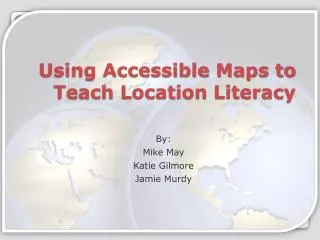
Using Accessible Maps to Teach Location Literacy By: Mike May Katie Gilmore Jamie Murdy
Provides spoken and on-screen map data and 15 million points of interest for U.S. states, territories, and Canada. • It speaks on any Windows® computer whether or not the computer has screen reading software installed. • Can be used for both classroom and O&M lessons Accessible Maps Description
Verbal and visual description of physical space and what it contains. • Street map of the location for people with visual impairments. • Virtually explore streets and learn layout by moving to the next intersection or by making left or right turns Accessible Maps Description
Set a destination and track the distance and compass heading to that destination • Save, reverse, review, and print or emboss pedestrian or vehicle routes • Record or type descriptive information about a particular intersection, parking lot, building, or other location; and attach that information so that you can access it when you explore the map Benefits of Accessible Maps
Learn about surroundings and have access to visual signs. • “Look around” to gather information about the travel environment, including street names, intersections, points of interest, city, etc. • Mental and visual mapping skills • Can be introduced with tactile maps (example: T Maps or Chang Kit) Access to Location Information
Left and right concepts • Introduces Cardinal Directions • Clock face directions • Applies geography and social studies core curriculum concepts • Environmental concepts including shapes of intersections, direction of travel, sidewalks, types of streets etc. • Low vision features Introduces Important Concepts
O&M lesson • What is around Student’s School • Finding POIs • Creating Route to nearby POI to preview for lesson Scenarios
Explore Washington DC for Social Studies • Explore map of Washington DC • Learn about major historical landmarks Scenarios